


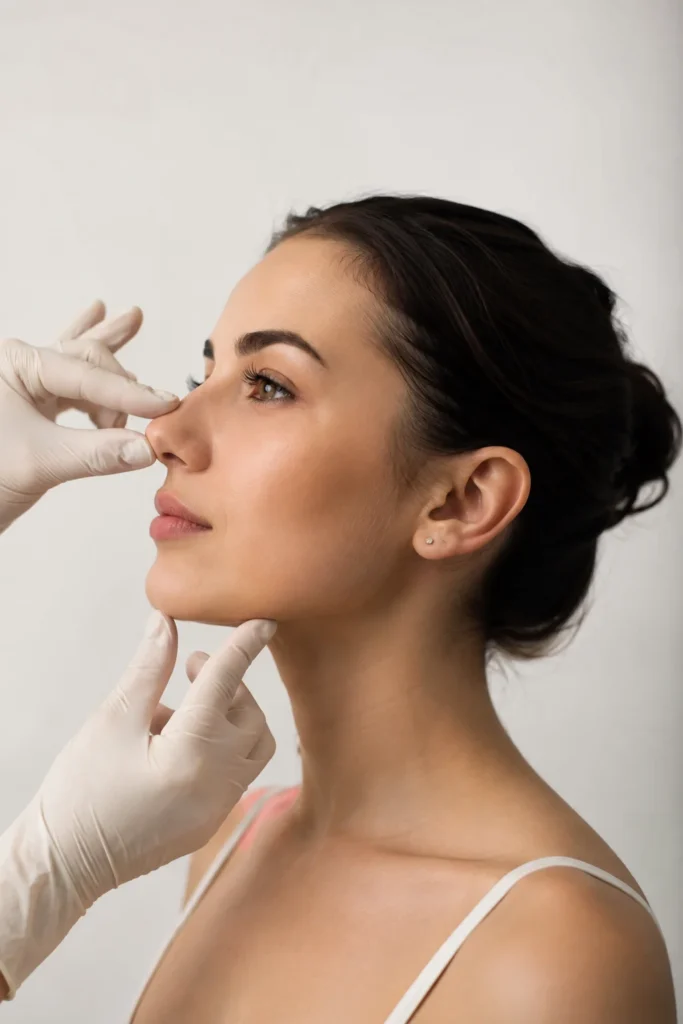
Rhinoplasty for Thick Skin: Does Skin Type Affect Results? Yes, skin type can affect how the nose looks during recovery and how clearly the final contours appear after surgery. Thick nasal skin tends to hide fine structural details more than thin skin, and swelling may take longer to settle. However, thick skin does not prevent successful rhinoplasty results. With careful surgical planning, strong structural support, realistic expectations, and enough healing time, patients with thick skin can achieve a balanced and natural-looking nasal shape.
Rhinoplasty involves much more than simply making the nose smaller. The surgeon reshapes the underlying bone and cartilage while also considering skin thickness, cartilage strength, facial proportions, nasal tip definition, and breathing function. Skin acts as a covering over the new nasal framework, so its thickness directly influences how visible those structural changes become.
This difference becomes especially important in patients with thick or sebaceous nasal skin. A surgeon may create a beautifully refined cartilage framework, but thicker skin can soften the appearance of sharp transitions and delicate tip details. For this reason, Rhinoplasty planning for thick skin requires a slightly different strategy from surgery performed on a thin-skinned nose.
Table of Contents
ToggleWhat Does Thick Skin Mean in Rhinoplasty?
Thick nasal skin usually contains a denser dermal layer and more active sebaceous glands. It often appears more noticeable around the nasal tip and lower third of the nose. Some patients also have larger pores or naturally oilier skin in this area.
A person may have relatively normal skin over the bridge of the nose but significantly thicker tissue around the tip. Because of this variation, surgeons evaluate different parts of the nose separately rather than simply describing the entire nose as “thick-skinned.”
Skin thickness also differs naturally between individuals. Genetics, ethnicity, age, skin quality, and sebaceous gland activity can all influence the appearance and behavior of nasal skin.
During consultation, the surgeon examines how flexible the skin feels, how much soft tissue covers the cartilage, and how clearly the existing nasal framework appears through the surface.
This evaluation helps determine how much definition the surgeon can realistically create.
How Does Thick Skin Affect Rhinoplasty Results?
Thick skin influences rhinoplasty mainly because it covers the cartilage and bone underneath the nose. Think of the nasal framework as the structure and the skin as the layer that drapes over it.
When the skin is thin, even very small changes to cartilage can become visible. This can create sharp definition, but thin skin can also reveal tiny irregularities.
Thick skin works differently. It tends to conceal minor irregularities, which can actually provide an advantage in some cases. At the same time, it can hide subtle sculpting of the nasal tip.
Patients with thicker skin may therefore notice a softer and slightly less sharply defined nasal tip compared with someone who has very thin skin.
This does not mean the nose cannot look elegant or refined. Instead, surgeons often focus on creating a strong, well-supported framework that remains visible beneath the thicker tissue.
For people considering Rhinoplasty in Turkey, skin thickness should form part of the consultation rather than becoming a reason to avoid surgery.
Why Nasal Tip Definition Requires Special Planning
The nasal tip often creates the greatest challenge in thick-skinned rhinoplasty.
The tip contains several cartilage structures that determine projection, rotation, symmetry, and definition. When thick soft tissue covers these structures, delicate cartilage changes may not show clearly through the skin.
For this reason, the surgeon often avoids aggressive cartilage reduction.
Removing too much cartilage may actually weaken the nasal framework. Thick skin then places additional weight over the weakened structure, which can reduce tip definition over time.
Instead, surgeons often focus on strengthening and reshaping existing cartilage.
Cartilage grafts may help create stronger tip support when necessary. These grafts can improve projection and shape while supporting the soft tissue envelope.
The goal is not to create an unnaturally sharp nasal tip. The goal is to achieve definition that fits the patient’s facial proportions and remains stable during long-term healing.
Can Thick Skin Make Swelling Last Longer?
Yes. Thick-skinned noses often hold postoperative swelling longer, especially around the nasal tip.
After surgery, the body naturally sends fluid and inflammatory cells to the treated tissues. This response forms part of normal healing.
In thin-skinned patients, swelling may become less noticeable relatively quickly. In thick-skinned patients, residual swelling can remain visible for a longer period.
The nasal bridge often begins to settle before the tip. Patients may therefore feel that the bridge looks refined while the tip still appears wide, round, or swollen during the early months.
This situation can cause unnecessary concern when patients expect their nose to reach its final shape very quickly.
Rhinoplasty requires patience in every skin type, but thick skin can extend the visible healing process.
The nose may continue changing gradually for many months as swelling decreases and the skin adapts to the new underlying structure.
How Long Does Thick-Skin Rhinoplasty Take to Heal?
There is no single healing timeline that applies to every patient.
Most people experience noticeable swelling during the first several weeks. Bruising around the eyes usually improves earlier than deeper nasal swelling.
Over the following months, the bridge and upper portions of the nose often become more defined. The nasal tip typically takes longer.
Thick-skinned patients may continue seeing subtle changes for 12 months or longer. In some cases, tip refinement continues beyond that point.
This slow progression does not necessarily indicate a problem. Thick soft tissue simply takes longer to contract and settle around the reconstructed cartilage.
Patients should therefore avoid judging their final appearance too early.
Photographs taken every few months often make gradual improvements easier to recognize because day-to-day changes can seem almost invisible.
Does Thick Skin Limit How Small the Nose Can Become?
In some cases, yes.
A surgeon cannot always reduce a thick-skinned nose as aggressively as a patient initially imagines.
The skin needs enough structural support underneath it. If the surgeon removes too much cartilage or bone, the skin may not contract neatly over the smaller framework.
This can lead to poor definition or an unbalanced appearance.
Instead of simply reducing nasal size, the surgeon often reshapes and strengthens the framework to create better proportions.
This approach becomes especially important for patients seeking a smaller or more refined nasal tip.
A successful operation should complement the entire face rather than focus only on making the nose as small as possible.
That principle applies across Facial Surgeries in Turkey, where facial balance and proportion usually matter more than isolated measurements.
Can Thick Skin Be an Advantage in Rhinoplasty?
Although thick skin creates certain challenges, it also offers some advantages.
Thin skin can reveal even tiny irregularities in bone or cartilage. A very small bump or asymmetry may become visible through the skin after surgery.
Thicker skin provides more coverage over the nasal framework.
This natural cushioning can hide subtle irregularities and create a smoother overall appearance.
The trade-off involves definition. While thick skin hides minor imperfections, it can also hide some of the fine sculpting performed during surgery.
Experienced surgeons account for both characteristics when planning the procedure.
Rather than treating thick skin as a disadvantage, they adjust the surgical technique around its behavior.
Why Structural Support Matters So Much
Strong cartilage support plays a central role in thick-skin rhinoplasty.
The skin and soft tissues create downward pressure over the nasal framework. If the cartilage lacks adequate strength, the tip may lose definition or projection as healing progresses.
For this reason, surgeons may preserve more cartilage rather than removing large amounts.
They may also reposition cartilage or use grafts from the patient’s own nasal septum when additional support becomes necessary.
This structural approach helps the nose maintain its shape while the skin gradually contracts around it.
Modern Rhinoplasty often emphasizes preservation and support rather than aggressive reduction, particularly in patients with thicker skin.
Does Oily or Sebaceous Skin Affect Recovery?
Some thick-skinned patients also have oily or sebaceous skin around the nose.
Sebaceous skin contains active oil glands and can appear more porous or textured. During recovery, temporary changes in oil production may occur because patients clean their nose differently and wear a nasal splint during the early healing period.
Once the splint comes off, some patients notice increased oiliness, dryness, or temporary changes in skin texture.
Gentle skincare usually helps the skin return to its usual condition.
Patients should avoid harsh exfoliation, squeezing pores, or aggressive cosmetic treatments while the nose remains sensitive.
The surgeon can provide guidance about when patients can safely return to their normal skincare routine.
How Can Surgeons Improve Definition in Thick-Skinned Noses?
Successful thick-skin rhinoplasty depends on creating enough structural definition beneath the soft tissue.
Instead of relying on very small cartilage changes, surgeons may create stronger lines and better-supported contours.
This does not mean creating an exaggerated or artificial nose.
The surgeon still needs to maintain harmony between the nose, forehead, cheeks, lips, and chin.
For some patients, improving projection can actually make the tip appear more refined. For others, adjusting the nasal bridge creates better balance without dramatically reducing the tip.
Every nose requires an individual strategy.
Patients researching Rhinoplasty in Turkey should therefore look beyond standard before-and-after photos and consider whether the surgeon regularly treats patients with similar skin characteristics.
Why Realistic Expectations Are Important
Expectations play a major role in satisfaction after rhinoplasty.
A patient with thick skin may show a surgeon a photograph of a very narrow, sharply defined nose belonging to someone with extremely thin skin.
That reference image can help communicate aesthetic preferences, but it may not represent a realistic anatomical goal.
The surgeon must work with the patient’s own cartilage, skin, bone structure, and facial proportions.
A natural result usually comes from improving balance rather than copying another person’s nose.
During consultation, patients should discuss what level of tip definition appears realistic and how long healing may take.
Clear communication before surgery can prevent unnecessary disappointment during recovery.
Does Skin Thickness Affect Natural-Looking Results?
Natural-looking rhinoplasty depends on proportion, not skin thickness alone.
A thick-skinned nose can look highly natural and refined when the surgeon creates a framework suited to the patient’s anatomy.
The ideal nose should not look disconnected from the rest of the face.
Instead, it should complement features such as the eyes, cheeks, chin, and lips.
This broader perspective also guides many Facial Surgeries in Turkey, where treatment planning often considers facial harmony rather than changing one feature in isolation.
For some patients, a slightly stronger nasal tip may actually look more natural than an extremely narrow one.
What Should Patients Ask During Consultation?
Patients with thick skin can benefit from asking specific questions during their rhinoplasty consultation.
They may want to ask how the surgeon evaluates skin thickness, how much nasal tip definition seems realistic, and whether additional cartilage support may play a role in the operation.
It also helps to ask about the expected swelling timeline.
A surgeon who regularly treats thick-skinned noses should explain that recovery can take time and that the final nasal tip may emerge gradually.
Before-and-after photographs of patients with similar anatomy can also provide useful context.
Rather than focusing only on dramatic transformations, patients should look for consistent facial balance, stable tip support, natural bridge lines, and symmetry.
Thick Skin Does Not Mean Poor Rhinoplasty Results
Thick skin changes the way surgeons plan rhinoplasty, but it does not automatically reduce the quality of the outcome.
The key lies in understanding how skin interacts with the cartilage and bone underneath it.
Patients with thick skin often benefit from strong structural support, conservative tissue reduction, careful tip shaping, and realistic expectations about recovery.
They also need patience because swelling around the tip can take longer to disappear.
When surgical planning respects these anatomical differences, thick-skinned patients can achieve a nose that looks refined, proportionate, and natural within the context of their own facial features.
Frequently Asked Questions
1. Is rhinoplasty harder with thick skin?
Thick skin can make nasal tip refinement more technically demanding because it hides subtle cartilage details. Experienced surgeons account for this by creating stronger structural support and carefully shaping the nasal framework.
2. How long does swelling last after thick-skin rhinoplasty?
Visible swelling usually decreases gradually over several months, but the nasal tip may continue refining for 12 months or longer. Each patient heals at a different rate.
3. Can thick skin become thinner after rhinoplasty?
Rhinoplasty does not dramatically change a person’s natural skin type. As swelling decreases and the soft tissue adapts to the new nasal framework, however, the nose may gradually look slimmer and more defined.
4. Can people with thick skin achieve a defined nasal tip?
Yes. Surgeons can improve tip definition by reshaping and supporting the underlying cartilage. The final level of sharpness depends on the patient’s skin thickness, anatomy, cartilage strength, and healing response.
5. Does thick skin increase the risk of a bad rhinoplasty result?
Thick skin alone does not determine whether rhinoplasty succeeds. Surgical technique, structural support, postoperative healing, individual anatomy, and realistic expectations all influence the final appearance.