


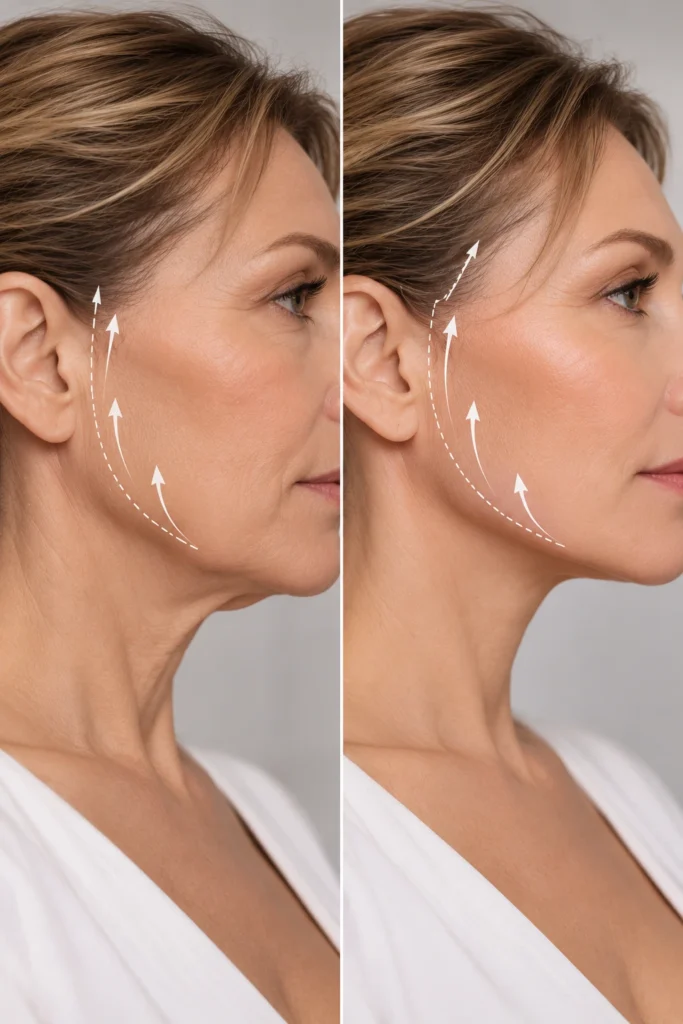
Facial aging affects everyone differently. Some people first notice a softer jawline, while others experience deeper nasolabial folds, cheek descent, or loose skin around the neck. With several surgical techniques available, deciding which procedure offers the most appropriate improvement can feel challenging. Comparing the surgical approach, recovery experience, longevity, and limitations of each technique provides a clearer picture of what to expect.
Table of Contents
ToggleWhat Is the Difference Between MACS Face Lift and Deep Plane Face Lift?
The primary difference between MACS and deep plane face lifting involves how surgeons access and reposition the underlying facial tissues.
Both techniques address visible signs of aging, but they use different methods to restore facial contours. A MACS lift relies on suspension sutures to elevate tissues through relatively short incisions, while a deep plane lift releases selected facial ligaments and repositions deeper tissue layers.
Patients researching facelift in Istanbul, Turkey often compare these procedures because they want to understand whether a less extensive approach can deliver the same improvement as deeper facial rejuvenation.
What Is a MACS Face Lift?
MACS stands for Minimal Access Cranial Suspension. The MACS Face Lift technique focuses on lifting facial tissues using strategically placed sutures that support the superficial musculoaponeurotic system, commonly called the SMAS.
Surgeons typically create shorter incisions around the ear and temporal hairline. They then use suspension sutures to elevate selected tissues and improve facial definition.
A MACS lift commonly targets:
Mild to moderate jowling
Early jawline sagging
Lower facial tissue descent
Selected cheek contour changes
Loss of definition along the lower face
Patients who want targeted rejuvenation without extensive tissue dissection may consider this technique.
However, a MACS lift does not address every pattern of facial aging equally. Significant neck laxity or advanced tissue descent may require another approach.
What Is a Deep Plane Face Lift?
The Deep Plane Face Lift technique repositions facial tissues by working beneath the SMAS layer in selected anatomical regions.
The surgeon releases retaining ligaments that restrict tissue movement, allowing the cheek and lower facial tissues to move as a more integrated unit.
This approach can address facial descent that involves deeper structures rather than focusing primarily on skin tightening.
A deep plane technique may improve:
Pronounced jowls
Descended cheek tissues
Lower facial sagging
Loss of jawline definition
Certain neck contour concerns
Deep folds associated with tissue descent
The precise degree of improvement depends on the patient’s anatomy and the surgeon’s chosen technique.
Which Face Lift Technique Looks More Natural?
One of the most common concerns about facial rejuvenation involves looking noticeably different after surgery.
Many patients want a fresher appearance without losing their recognizable facial expressions.
Both MACS and deep plane lifting can create natural-looking improvements when surgeons respect the original facial anatomy.
Does a Deep Plane Face Lift Prevent an Overly Tight Appearance?
Deep plane lifting allows surgeons to reposition deeper facial structures rather than relying heavily on tension across the skin.
This approach may help create smoother contours around the cheeks, jawline, and lower face.
However, the technique itself does not guarantee a natural appearance. Excessive lifting, inappropriate tissue repositioning, or unrealistic aesthetic goals can affect the outcome.
A well-planned operation aims to restore facial balance rather than dramatically alter the patient’s identity.
Can a MACS Face Lift Look Just as Natural?
A MACS lift can create subtle improvements that preserve familiar facial features.
Patients with early jowling and moderate facial laxity may achieve a refreshed appearance without extensive repositioning.
The vertical direction of the suspension sutures helps elevate selected tissues and improve lower facial definition.
However, patients with significant cheek descent or substantial neck laxity may experience less improvement than they expect from a limited approach.
The most natural-looking procedure is usually the one that addresses the patient’s actual anatomical concerns without excessive correction.
Who Is a Good Candidate for a MACS Face Lift?
MACS lifting often appeals to patients who notice early signs of facial aging but do not require extensive tissue repositioning.
People with reasonable skin elasticity, mild to moderate jowling, and limited neck laxity may benefit from this approach.
Is a MACS Face Lift Suitable for People in Their 40s?
Some patients begin considering facial rejuvenation in their 40s when they notice early changes around the jawline and cheeks.
A MACS lift may suit individuals in this age group who have localized sagging and relatively good skin elasticity.
However, chronological age alone does not determine the most appropriate technique.
A person in their 40s with significant facial descent may need a different procedure, while someone in their 60s with limited laxity may benefit from a more conservative approach.
Can MACS Lifting Improve the Neck?
A MACS lift may improve the upper neck and the transition between the jawline and neck.
However, its ability to correct pronounced neck laxity or prominent platysmal bands can be limited.
Patients who have substantial loose skin beneath the chin may need a procedure that specifically addresses the neck.
A detailed examination helps determine whether MACS lifting alone can meet the patient’s expectations.
Who Benefits Most From a Deep Plane Face Lift?
Deep plane lifting may suit patients who experience more pronounced facial tissue descent, particularly around the cheeks, jowls, and jawline.
This procedure allows surgeons to mobilize deeper tissues and address certain anatomical changes that shorter-incision techniques may not fully correct.
Is Deep Plane Face Lift Better for People Over 50?
Many people consider deep plane lifting in their 50s or 60s because facial tissue descent often becomes more noticeable with age.
However, the technique does not belong exclusively to older patients.
Skin quality, facial anatomy, previous treatments, and the location of sagging matter more than age alone.
An individual with substantial jowling may benefit from deeper repositioning, while someone with milder changes may not need such an extensive procedure.
Can Deep Plane Lifting Improve Nasolabial Folds?
Nasolabial folds extend from the sides of the nose toward the corners of the mouth.
These folds may become more noticeable as cheek tissues descend and facial volume changes.
Deep plane lifting can reposition selected midfacial tissues, which may soften folds associated with tissue descent.
However, natural facial creases do not disappear completely, and the degree of improvement varies.
Patients should understand that facial folds also reflect skin quality, volume distribution, and individual anatomy.
MACS Face Lift vs Deep Plane Face Lift: Which Has a Faster Recovery?
Recovery time plays an important role in choosing between facial rejuvenation techniques. Many patients want to know how quickly they can return to work, resume social activities, and see visible improvements.
Both procedures involve swelling, bruising, and temporary changes in facial sensation. However, the extent of tissue dissection and individual healing patterns influence the recovery experience.
How Long Does MACS Face Lift Recovery Take?
A MACS lift generally involves shorter incisions and less extensive tissue dissection than many deep plane procedures.
Patients commonly experience swelling and bruising during the first one to two weeks. Some return to light daily activities within approximately 10 to 14 days, depending on their healing progress.
Although the initial recovery may feel manageable, residual swelling and temporary numbness can continue for several weeks.
Patients should avoid strenuous exercise until their surgeon confirms that they can safely resume physical activities.
How Long Does Deep Plane Face Lift Recovery Take?
Deep plane face lift recovery varies according to the extent of surgery and whether the surgeon combines additional procedures.
Many patients need approximately two to three weeks before they feel comfortable returning to routine social activities.
Swelling and bruising gradually decrease, but subtle changes in facial contour may continue for several months.
A deeper surgical approach does not automatically mean a significantly longer recovery for every patient. Surgical technique, individual healing, and postoperative care all influence the timeline.
Does MACS or Deep Plane Face Lift Last Longer?
Patients often want to know which technique provides longer-lasting facial rejuvenation.
Both procedures reposition facial tissues, but neither stops the natural aging process.
Skin elasticity, genetics, weight changes, sun exposure, and surgical technique influence how facial contours evolve after surgery.
How Long Do MACS Face Lift Results Last?
A MACS lift can provide noticeable improvement for several years, especially when the surgeon selects patients with appropriate tissue characteristics.
However, the longevity of the improvement varies.
Patients with significant tissue laxity may notice recurring sagging sooner if the original procedure does not sufficiently address deeper facial structures.
Maintaining stable body weight and protecting the skin from excessive sun exposure may help preserve the appearance of the treated areas.
Does a Deep Plane Face Lift Provide Longer-Lasting Results?
Deep plane lifting may produce durable improvement because the surgeon releases selected retaining ligaments and repositions deeper facial tissues.
However, available research does not establish that every deep plane procedure lasts longer than every MACS lift.
Surgical technique, individual anatomy, and the degree of correction strongly influence long-term results.
Patients should avoid choosing a procedure based solely on promises about how many years the improvement will last.
Can MACS or Deep Plane Face Lift Be Combined With Other Facial Procedures?
Facial aging rarely affects just one area. Some patients notice lower facial sagging alongside eyebrow descent, neck laxity, or changes around the eyes.
In selected cases, surgeons may recommend complementary treatments to create more balanced facial proportions.
People researching facial surgeries in Turkey often compare different procedures to understand which facial regions each technique addresses.
Can You Combine a Face Lift With Temporal Lifting?
Temporal lifting focuses on the outer eyebrow and temple region, while MACS and deep plane lifting primarily address structures within the cheeks, jawline, and lower face.
Patients exploring Deep Temporal Face Lift may want to improve the appearance of their outer brow or temple contours alongside lower facial rejuvenation.
However, temporal lifting and deep plane face lifting are not interchangeable techniques.
A temporal procedure targets the upper lateral face, while a deep plane approach generally focuses on the middle and lower facial structures.
Combining procedures may benefit selected patients, but it also increases the scope of surgery. The surgeon must carefully assess operative time, individual risks, and recovery requirements.
Can a Face Lift Correct Under-Eye Wrinkles?
A face lift primarily improves sagging tissues around the cheeks, jawline, and neck.
It does not directly correct every wrinkle around the eyes.
Fine lines, lower eyelid bags, and skin texture changes may require other treatments.
Some patients benefit from combining facial lifting with eyelid surgery or selected skin treatments, depending on their concerns.
A comprehensive facial assessment helps identify which changes come from tissue descent and which require a different approach.
Which Technique Is Better for Jawline and Neck Definition?
Loss of jawline definition frequently motivates patients to explore facial rejuvenation.
As facial tissues descend, jowls become more prominent, and the transition between the lower face and neck may appear less defined.
Both techniques can improve selected concerns, but the degree of correction differs.
Can a MACS Lift Reduce Jowls?
MACS lifting uses suspension sutures to elevate tissues and improve the lower facial contour.
This approach may provide noticeable improvement for patients with mild to moderate jowling.
However, substantial tissue descent may require greater mobilization than a standard MACS technique offers.
The surgeon must consider the position of facial fat compartments, skin elasticity, and underlying anatomy before recommending treatment.
Does Deep Plane Lifting Create a Sharper Jawline?
A deep plane lift allows surgeons to reposition deeper facial structures, potentially improving more pronounced jowling.
This may restore clearer definition along the mandibular border.
However, jawline shape also depends on bone structure, fat distribution, and neck anatomy.
Some patients need additional neck-focused treatment to address loose skin or platysmal bands.
A deep plane lift alone does not guarantee a sharply defined jawline in every patient.
What Are the Risks of MACS and Deep Plane Face Lift Surgery?
Every surgical facial rejuvenation procedure carries potential complications.
Both MACS and deep plane lifting require careful surgical planning, appropriate patient selection, and postoperative monitoring.
Possible risks include:
Bleeding and hematoma
Infection
Temporary or persistent numbness
Facial asymmetry
Unfavorable scarring
Delayed wound healing
Hairline changes
Facial nerve injury
Prolonged swelling
Dissatisfaction with the aesthetic appearance
Patients should discuss these risks before deciding which technique best suits their needs.
Is Deep Plane Face Lift Surgery More Dangerous?
Deep plane surgery involves dissection near important facial nerves and other anatomical structures.
This requires advanced anatomical knowledge and precise surgical technique.
However, a deeper approach does not automatically produce more complications in every patient.
The surgeon’s experience, surgical method, medical assessment, and individual risk factors influence safety.
Some studies report comparable complication profiles between selected lifting techniques, although differences in study methods limit broad comparisons.
Does a MACS Face Lift Leave Smaller Scars?
MACS lifting typically uses shorter incisions than many extensive traditional techniques.
Surgeons commonly position these incisions around the ear and adjacent hairline.
However, incision length alone does not determine scar visibility.
Skin characteristics, wound healing, surgical tension, and postoperative care all influence the final appearance.
Patients should ask their surgeon to explain the planned incision placement and realistic scar expectations.
How Do You Choose the Right Face Lift Surgeon?
Selecting a qualified surgeon is just as important as choosing the procedure itself.
An experienced aesthetic plastic surgeon evaluates facial anatomy, skin quality, tissue descent, medical history, and aesthetic goals before recommending a surgical technique.
The consultation should focus on your individual concerns rather than presenting one procedure as universally superior.
What Questions Should You Ask Before Surgery?
A productive consultation helps clarify the expected improvement and potential limitations.
Consider discussing the following questions:
Which procedure best addresses my facial sagging?
Will the technique improve both my jawline and neck?
How much tissue repositioning does my anatomy require?
Where will the incisions appear?
What recovery timeline should I expect?
What complications could affect my treatment?
How do you manage revision surgery if necessary?
Reviewing before-and-after photographs of patients with similar facial characteristics may help you understand realistic possibilities.
However, no photograph can guarantee an identical outcome.
How Do You Decide Between MACS and Deep Plane Face Lift?
Choosing the right procedure begins with understanding the location and severity of your facial aging.
A MACS lift may offer appropriate improvement when mild to moderate jowling and limited lower facial laxity represent your main concerns.
A deep plane lift may provide greater tissue mobilization when pronounced cheek descent, jowling, and deeper facial structural changes affect your appearance.
However, selecting the more extensive procedure does not automatically produce a better outcome.
Similarly, choosing a shorter-incision technique does not always mean easier recovery or a more natural appearance.
The best surgical approach balances your facial anatomy, desired degree of improvement, recovery expectations, and medical considerations.
A personalized surgical assessment helps identify the technique that can improve your facial contours while preserving your recognizable features and natural expressions.
Frequently Asked Questions About MACS Face Lift vs Deep Plane Face Lift
1. Is MACS Face Lift Better Than Deep Plane Face Lift?
Neither technique is universally better. MACS lifting may suit patients with mild to moderate facial sagging who want targeted tissue elevation through shorter incisions. Deep plane lifting may benefit individuals with more pronounced cheek descent, jowls, or deeper facial laxity. The most suitable approach depends on anatomical characteristics, aesthetic expectations, and the extent of correction required.
2. Which Face Lift Looks More Natural: MACS or Deep Plane?
Both techniques can create natural-looking rejuvenation when an appropriately qualified surgeon performs them. MACS lifting uses suspension sutures to elevate selected facial tissues, while deep plane lifting repositions deeper structures after releasing specific anatomical attachments. Natural results depend on balanced tissue movement, suitable skin tension, and preservation of facial proportions. Neither technique guarantees superior aesthetic results for every patient.
3. Is MACS Face Lift Recovery Faster Than Deep Plane Recovery?
MACS lifting may involve a more manageable early recovery because it typically uses shorter incisions and less extensive tissue dissection. However, the difference varies according to surgical technique and patient characteristics. Many patients need approximately one to three weeks before resuming normal social activities after either procedure. Residual swelling, tightness, and temporary numbness can persist beyond this period.
4. Can a Deep Plane Face Lift Correct Sagging Better Than MACS?
A deep plane lift may provide greater correction in patients with pronounced tissue descent because it allows surgeons to mobilize deeper facial structures. This can help address certain cheek, jawline, and lower facial concerns. However, individuals with limited sagging may not need extensive tissue repositioning. A surgeon should assess the location and severity of facial aging before recommending either technique.
5. Can You Have a Deep Plane Face Lift After a MACS Lift?
Some patients consider additional facial rejuvenation years after undergoing MACS lifting. A surgeon may recommend a deep plane approach or another revision technique depending on existing scars, tissue mobility, facial anatomy, and the original surgical method. Previous surgery can alter normal tissue planes, making revision procedures more complex. A detailed examination helps determine whether another lifting procedure is appropriate and what improvement patients can realistically expect.