


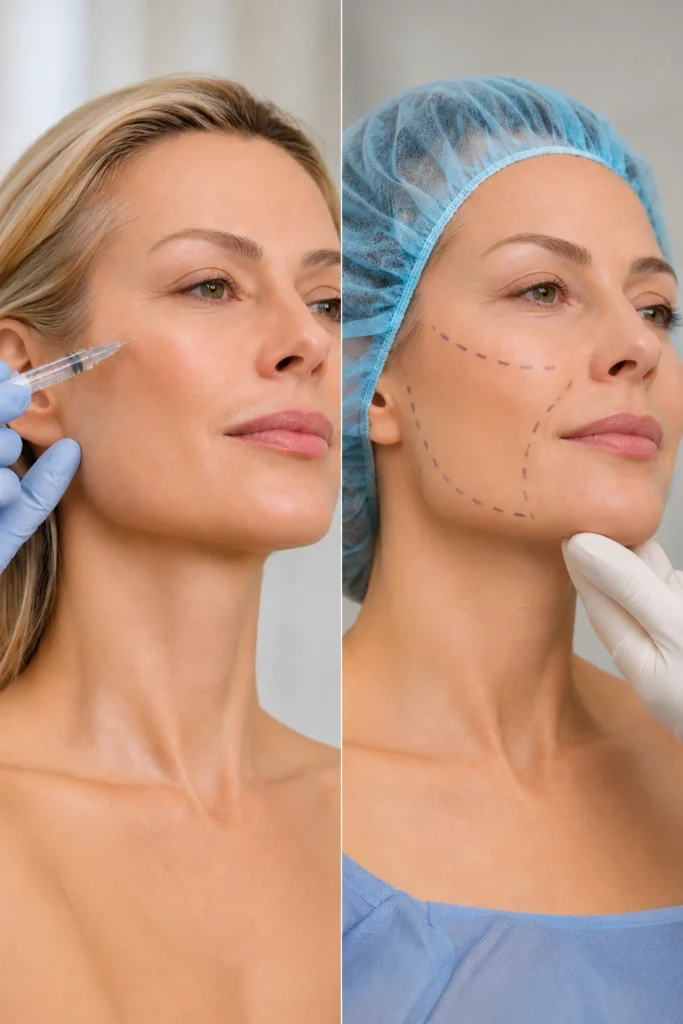
Choosing between these approaches depends on more than age. Some patients want to refresh tired-looking features without undergoing surgery, while others struggle with loose skin that injectable treatments cannot adequately address. Understanding the capabilities and limitations of each approach helps patients make informed decisions about facial rejuvenation.
Table of Contents
ToggleWhat Is the Difference Between a Liquid Facelift and a Surgical Facelift?
Both procedures aim to improve facial appearance, but they address different aspects of aging.
A liquid facelift primarily targets volume loss, facial contours, and selected wrinkles. A surgical facelift focuses on repositioning descended tissues and improving skin laxity.
Patients exploring Facial Surgeries in Istanbul, Turkey often compare surgical and non-surgical approaches before deciding which treatment best matches their concerns.
What Is a Liquid Facelift?
A liquid facelift is a non-surgical facial rejuvenation approach that combines injectable treatments to improve selected signs of aging.
Depending on the patient’s needs, treatment may include hyaluronic acid fillers to restore volume in the cheeks, temples, or other facial areas. Botulinum toxin injections may also help soften expression lines.
The goal is to create a refreshed appearance without surgically repositioning facial tissues.
However, a liquid facelift cannot remove significant excess skin or provide the structural lifting effects of surgery.
What Is a Surgical Facelift?
A surgical facelift addresses facial sagging by repositioning deeper tissues and adjusting excess skin.
Modern techniques often focus on the superficial musculoaponeurotic system (SMAS), a layer of connective tissue that contributes to facial support.
Patients considering Facelift in Turkey should understand that surgical planning varies according to facial anatomy, skin quality, and the degree of tissue descent.
A facelift can improve lower-face contours and jawline definition, but it does not stop the natural aging process.
Which Procedure Looks More Natural?
Natural-looking facial rejuvenation depends on choosing an appropriate treatment rather than simply selecting the least invasive option.
Both injectable and surgical procedures can create balanced improvements when practitioners respect facial proportions.
Can a Liquid Facelift Look Natural?
A liquid facelift may produce subtle improvements when the practitioner uses appropriate filler volumes and carefully selects treatment areas.
For example, restoring modest cheek volume can soften certain facial contours without dramatically changing the patient’s appearance.
However, excessive filler can create unwanted fullness or distort facial proportions.
Patients with significant sagging may find that adding volume makes the face appear heavier rather than more lifted.
Does a Surgical Facelift Make Your Face Look Tight?
A properly planned surgical facelift aims to improve facial contours without creating excessive tension on the skin.
Modern techniques often reposition deeper tissues rather than relying primarily on skin tightening.
However, surgical outcomes vary, and excessive tension or inappropriate technique can produce an unnatural appearance.
The surgeon must consider facial anatomy, skin elasticity, and individual aesthetic goals.
Liquid Facelift vs Surgical Facelift: Which Lasts Longer?
Treatment longevity represents one of the most important differences between injectable and surgical facial rejuvenation.
A liquid facelift provides temporary changes because the body gradually metabolizes many injectable products.
A surgical facelift produces longer-lasting structural changes, although aging continues after surgery.
How Long Does a Liquid Facelift Last?
The duration depends on the injectable products, treatment areas, and individual metabolism.
Hyaluronic acid fillers may provide visible improvements for approximately 6 to 18 months, although some products and treatment areas can retain effects longer.
Botulinum toxin typically lasts around three to four months.
Patients may require maintenance appointments to preserve their preferred appearance.
How Long Does a Surgical Facelift Last?
Many patients enjoy visible improvements for several years after surgery.
Depending on the technique, anatomy, and aging patterns, improvements may remain noticeable for approximately 7 to 10 years or longer.
However, these figures represent broad estimates rather than guaranteed timelines.
Sun exposure, smoking, weight fluctuations, and natural changes in skin elasticity influence long-term appearance.
Can a Liquid Facelift Fix Sagging Jowls?
Sagging jowls develop when facial tissues descend and skin elasticity decreases.
Injectable treatments may improve the appearance of mild contour irregularities, but they cannot physically reposition significantly descended tissues.
Can Fillers Improve Jawline Definition?
Dermal fillers can enhance selected areas along the jawline and chin.
For patients with mild volume deficiencies, this approach may create a more defined lower-face contour.
However, adding filler does not remove loose skin.
Excessive injections may also increase facial heaviness, especially when patients already have substantial jowling.
When Is Surgery Better for Jowls?
Patients with moderate or significant lower-face sagging may benefit more from surgical tissue repositioning.
A facelift can address descended tissues and improve jawline definition more directly than fillers.
The appropriate technique depends on the severity and location of facial aging.
What Is a MACS Facelift, and How Is It Different From Fillers?
A MACS facelift, or Minimal Access Cranial Suspension facelift, uses a surgical approach that lifts selected facial tissues through relatively limited incisions.
Unlike injectable treatments, this procedure physically repositions tissues rather than adding volume.
Patients researching MACS Face Lift in Turkey may consider this technique when they want surgical improvement but do not necessarily require more extensive facial correction.
Who May Benefit From a MACS Facelift?
A MACS facelift may suit selected patients with mild to moderate facial sagging, particularly around the cheeks and jawline.
The surgeon evaluates skin elasticity, facial structure, and tissue descent before recommending the procedure.
However, limited-incision surgery does not automatically mean minimal recovery or fewer risks.
Is a MACS Facelift Better Than a Liquid Facelift?
Neither approach is universally better.
A MACS facelift can reposition sagging tissues, while injectable treatments primarily address volume loss and certain wrinkles.
Patients with minimal sagging may prefer a non-surgical approach, whereas those with more noticeable tissue descent may benefit from surgery.
Liquid Facelift vs Midface Lift: Which Helps Sagging Cheeks?
Cheek aging involves several changes, including volume loss, tissue descent, and reduced skin elasticity.
A liquid facelift can restore selected areas of lost volume, but it cannot fully correct significant cheek descent.
A surgical midface lift focuses more directly on repositioning tissues in the central facial region.
Can Fillers Lift Sagging Cheeks?
Cheek fillers can create the appearance of improved projection and contour.
For patients with mild volume loss, this may make the face look refreshed.
However, fillers cannot reliably replace surgical lifting when facial tissues have descended significantly.
Adding too much volume may also create unwanted fullness.
When Should You Consider a Midface Lift?
Patients with noticeable cheek descent and changes around the central face may explore Midface Lift in Turkey as a surgical option.
A midface lift focuses on repositioning selected cheek tissues rather than simply increasing volume.
The surgeon evaluates the relationship between the cheeks, lower eyelids, and surrounding facial structures before recommending treatment.
Can a Liquid Facelift Improve the Neck?
A liquid facelift primarily addresses facial volume and selected wrinkles.
Injectables may help with certain neck concerns, but they cannot reliably remove significant loose skin or correct substantial neck sagging.
Can Injectables Tighten Loose Neck Skin?
Some injectable approaches may improve selected neck lines or muscle-related concerns.
However, their effects differ from surgical skin and tissue repositioning.
Patients with pronounced neck laxity may not achieve their desired improvement through injectables alone.
When Is a Neck Lift More Appropriate?
A Neck Lift in Turkey may suit patients with loose neck skin, visible neck bands, or reduced definition beneath the chin.
The procedure can address selected skin and deeper tissue concerns that injectable treatments cannot adequately correct.
Some patients benefit from combining facial and neck procedures when aging affects both regions.
Which Procedure Has a Faster Recovery?
Recovery time often influences the choice between liquid and surgical facial rejuvenation.
Injectable treatments generally involve less downtime, while surgery requires a longer healing period.
What Is Recovery Like After a Liquid Facelift?
Many patients return to routine activities shortly after injectable treatment.
However, temporary swelling, bruising, tenderness, and asymmetry can occur.
Some patients need several days for visible swelling to settle.
Although recovery is usually shorter than surgical recovery, injectable procedures still carry medical risks.
How Long Is Surgical Facelift Recovery?
Patients commonly experience swelling, bruising, tightness, and temporary sensory changes after facelift surgery.
Many return to non-strenuous daily activities within approximately two to three weeks, depending on the procedure and individual healing.
Residual swelling may continue improving for several months.
Surgeons provide personalized instructions about physical activity, wound care, and follow-up appointments.
Is a Liquid Facelift Safer Than Surgery?
A liquid facelift avoids surgical incisions and general anesthesia in many cases, but that does not make it risk-free.
Dermal fillers can cause bruising, infection, nodules, asymmetry, and vascular complications.
In rare cases, accidental injection into a blood vessel can cause tissue damage, blindness, or stroke.
What Are the Risks of a Surgical Facelift?
Surgical facelift risks include bleeding, infection, hematoma, scarring, nerve injury, skin-healing problems, and anesthesia-related complications.
Smoking, certain medical conditions, and individual healing characteristics can increase some risks.
A thorough consultation helps identify factors that may affect treatment suitability.
Can You Combine Fillers With a Surgical Facelift?
Yes. Some patients benefit from carefully planned injectable treatments after surgical healing.
Surgery can reposition descended tissues, while fillers may address residual volume deficiencies.
However, combining treatments requires appropriate timing and an individualized plan.
Not every patient needs both procedures.
Is a Liquid Facelift Cheaper Than a Surgical Facelift?
Liquid facelifts generally involve a lower initial treatment cost than surgical facelifts.
However, injectable treatments often require maintenance because their effects gradually diminish.
Do Repeated Fillers Cost More Over Time?
Patients who receive regular filler treatments may accumulate substantial expenses over several years.
The total depends on the number of treatment areas, product quantities, appointment frequency, and local pricing.
A lower initial cost does not necessarily mean a lower long-term expense.
Is a Surgical Facelift a One-Time Investment?
Surgery usually involves a higher initial cost, including surgical fees, facility expenses, anesthesia, and postoperative care.
Although improvements may last for years, patients can still experience further facial aging.
Some may choose additional procedures later.
Cost comparisons should account for expected benefits, maintenance needs, and individual treatment goals.
How Do You Choose Between a Liquid and Surgical Facelift?
The most suitable approach depends on the type of facial aging rather than age alone.
Patients with mild volume loss and limited skin laxity may prefer injectable treatments.
Those with more substantial jowling, loose skin, or descended facial tissues may benefit from surgical correction.
An experienced aesthetic plastic surgeon evaluates facial anatomy, skin quality, medical history, and aesthetic goals before recommending treatment.
What Should You Ask During Your Consultation?
Patients can ask whether their concerns involve volume loss, skin laxity, or deeper tissue descent.
They should also discuss expected improvement, treatment longevity, recovery requirements, potential complications, and maintenance.
Understanding what each procedure cannot achieve is just as important as knowing its potential benefits.
A personalized assessment helps patients choose a treatment that addresses their actual concerns without unnecessary intervention.
Frequently Asked Questions About Liquid Facelift vs Surgical Facelift
1. Is a Liquid Facelift as Effective as a Surgical Facelift?
A liquid facelift can improve mild volume loss, selected wrinkles, and certain facial contours, but it cannot reproduce the structural lifting effects of surgery. Surgical facelifts reposition descended tissues and address loose skin more directly. The appropriate treatment depends on the patient’s facial anatomy and degree of aging.
2. At What Age Should You Choose a Surgical Facelift Instead of Fillers?
There is no universal age for choosing surgery. Some patients develop noticeable facial sagging earlier, while others maintain good skin elasticity for many years. Surgeons evaluate tissue descent, skin quality, facial proportions, and individual goals rather than relying on age alone.
3. Can a Liquid Facelift Make Your Face Look Puffy?
Yes. Excessive filler volume or inappropriate placement can create unwanted fullness, particularly around the cheeks and lower face. Patients with significant sagging may notice that additional volume makes their features appear heavier. Careful treatment planning helps reduce this risk.
4. How Long Should You Wait Between Fillers and a Surgical Facelift?
The appropriate interval depends on the filler type, injection location, amount of product, and planned surgical technique. Some fillers remain in facial tissues longer than their visible cosmetic effects suggest. Patients should tell their surgeon about previous injections, including treatment dates and products, before scheduling surgery.
5. Can You Have a Liquid Facelift First and a Surgical Facelift Later?
Yes. Some patients begin with injectable treatments and consider surgery when facial sagging becomes more noticeable. Previous fillers do not automatically prevent future facelift surgery, but they may influence surgical planning. A qualified surgeon can assess existing filler, facial anatomy, and treatment history before recommending the next step.