


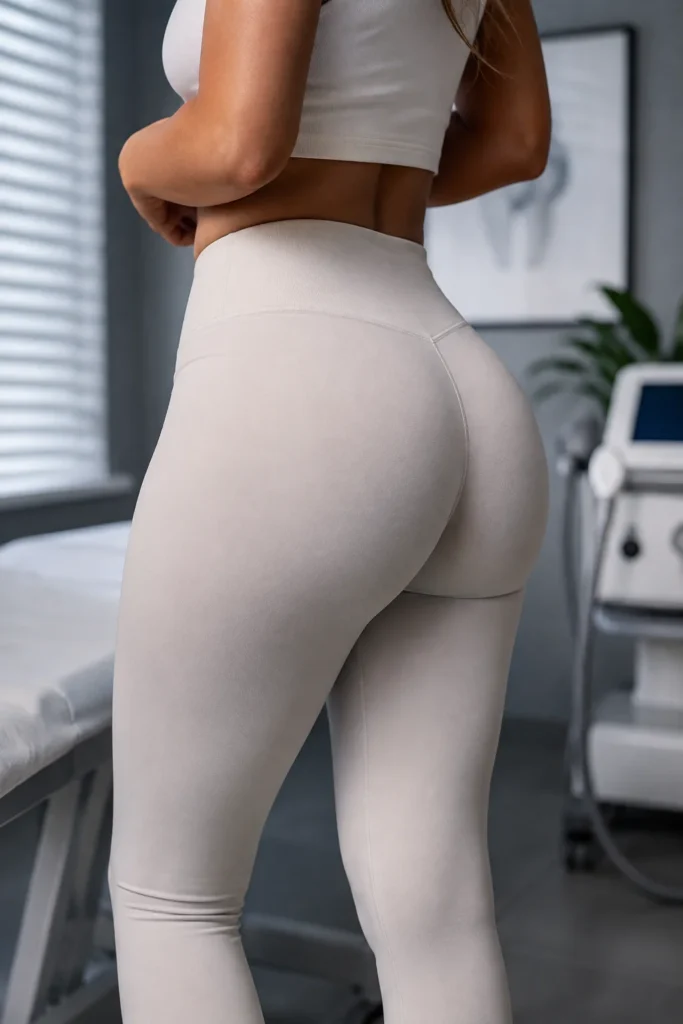
How Much Fat Is Needed for a BBL? The amount varies from person to person, but many Brazilian Butt Lift procedures involve transferring roughly 300 to 1,000 cc of purified fat per buttock, depending on the patient’s anatomy, available donor fat, desired shape, and the surgeon’s technique. The surgeon usually removes more fat through liposuction than they ultimately inject because the purification process reduces the usable volume. Rather than focusing on one fixed number, a successful BBL depends on creating proportions that suit your waist, hips, buttocks, and overall body frame.
A Brazilian Butt Lift combines liposuction with fat transfer to reshape the body. The surgeon removes fat from areas such as the abdomen, waist, flanks, lower back, or thighs, processes that fat, and carefully transfers suitable fat into the buttocks. Because every body stores fat differently, two patients who want a similar appearance may require very different treatment plans.
Table of Contents
ToggleHow Much Fat Is Usually Transferred During a BBL?
There is no universal amount of fat that every patient needs. Surgeons plan the procedure according to body structure rather than following a standard volume.
For some patients, transferring around 300 to 500 cc per side may create the desired improvement. Others may need 600, 800, or even 1,000 cc per side to achieve a fuller shape. These figures only provide a general reference. They do not determine what any individual patient should receive.
The desired transformation also matters. Someone who wants subtle contour enhancement may require considerably less fat than someone looking for a noticeably rounder or more projected appearance.
During BBL in Turkey, surgeons typically evaluate both the buttocks and the surrounding body areas. Removing fat from the waist, abdomen, and lower back can sometimes make the buttocks appear more defined even without transferring an extremely large amount of fat.
This is why BBL planning focuses heavily on proportion.
The Amount Removed Is Higher Than the Amount Injected
Patients sometimes assume that if a surgeon removes 3,000 cc of fat through liposuction, the entire amount can move into the buttocks. In reality, fat transfer does not work this way.
After liposuction, the surgeon processes the harvested material to separate healthy fat cells from blood, fluid, oil, and damaged tissue. Only suitable fat remains available for injection.
For example, a surgeon may remove several liters of liposuction material but eventually use only a portion of the purified fat for the actual transfer. The exact ratio varies according to the patient’s body, liposuction technique, fat quality, and processing method.
What Determines How Much Fat You Need for a BBL?
A good BBL plan starts with anatomy. Your surgeon looks at much more than the size of your buttocks.
Several factors influence how much fat the procedure may require:
Your current buttock volume and shape
Your waist-to-hip ratio
The amount of donor fat available
Your skin quality and elasticity
Your height and overall body frame
Your desired level of projection
Hip width and pelvic structure
Fat distribution around the abdomen, waist, back, and thighs
Previous liposuction or body contouring procedures
A patient with a small frame may achieve a noticeable transformation with relatively moderate fat transfer. A taller patient with a wider pelvis may require a larger volume to create a similar visual effect.
That is why comparing injection numbers from different patients rarely gives meaningful information.
Your Desired Shape Matters as Much as Volume
Patients often talk about BBL results in terms of size, but shape usually matters just as much.
Some people want more projection from the side. Others mainly want fuller hips to create a smoother hourglass silhouette. Another patient may have enough natural buttock volume but want the surgeon to correct hip dips or improve symmetry.
Each goal requires a different fat distribution strategy.
A surgeon performing a Brazilian Butt Lift in Turkey may divide the available fat across several regions instead of concentrating it in one spot. Strategic placement can improve the transition between the waist, hips, and buttocks while creating a more balanced profile.
Where Does the Fat for a BBL Come From?
Surgeons usually harvest fat from areas where patients naturally store excess volume. Common donor areas include the abdomen, flanks, waist, lower back, thighs, and sometimes the upper back.
The abdomen and flanks often provide particularly useful donor fat because contouring these areas also changes the relationship between the waist and buttocks.
This creates two effects at the same time: liposuction narrows selected areas, while fat transfer adds volume where the patient wants more fullness.
For many patients researching Body Surgeries in Turkey, this combined approach is one of the main reasons BBL attracts interest. Rather than treating the buttocks alone, the procedure reshapes several connected areas to improve overall body proportions.
How Much Donor Fat Do You Need?
You generally need more donor fat than the amount your surgeon plans to inject because not all harvested material remains suitable after purification.
Imagine that your treatment plan calls for approximately 700 cc of purified fat per buttock. Your surgeon may need to harvest substantially more than 1,400 cc in total to obtain enough healthy fat for transfer.
The required amount differs between patients because liposuction material contains different proportions of viable fat, fluid, and other tissue.
This also explains why very slim patients sometimes have fewer options for high-volume BBL procedures.
Can You Be Too Thin for a BBL?
Yes, some patients have too little body fat to achieve the amount of volume they want through fat transfer.
A BBL depends on your own fat reserves. If you have very little pinchable fat around the abdomen, waist, back, or thighs, your surgeon may not have enough donor tissue to create a dramatic increase in buttock size.
However, being slim does not automatically rule out the procedure.
Some thin patients still have enough localized fat for a smaller, shape-focused BBL. In these cases, the surgeon may concentrate on improving hip dips, enhancing contour, or creating modest projection rather than a large increase in volume.
The consultation matters especially for slim patients because an experienced surgeon can assess how much usable fat the body actually provides.
Trying to gain a large amount of weight solely for surgery does not always create predictable donor fat distribution. Anyone considering weight changes before a BBL should discuss the idea with their surgeon first.
How Much Fat Survives After a BBL?
Not every transferred fat cell survives permanently.
After fat transfer, the body establishes a new blood supply around the surviving fat cells. Some transferred fat naturally gets reabsorbed during the healing period. For this reason, the appearance during the first few weeks does not necessarily represent the final BBL size.
Surgeons account for expected fat retention when planning the transfer, but they still need to work within safe anatomical limits.
This is one reason patients should avoid choosing a surgeon based solely on who promises the largest possible transfer volume.
A larger injection does not automatically create a better or longer-lasting result.
Why More Fat Does Not Always Mean a Better BBL
It can be tempting to think that transferring more fat guarantees a more dramatic transformation. BBL surgery does not work according to a simple “more is better” rule.
The body has anatomical limits, and the surgeon needs to place fat within the appropriate tissue planes. Current safety-focused techniques emphasize fat placement in the subcutaneous layer rather than inside or beneath the gluteal muscles.
The surgeon also needs to consider how much volume the tissues can accommodate while preserving an attractive shape.
An excessively large buttock volume may look disproportionate to the thighs, waist, hips, or upper body. Careful shaping can often create a stronger visual transformation than simply maximizing the number of cubic centimeters transferred.
Does Liposuction Make a BBL Look Bigger?
Absolutely. Liposuction plays a major role in the visual effect of a BBL.
Imagine two patients receiving exactly the same amount of transferred fat. If one patient also receives carefully planned waist and flank contouring, the buttocks may appear significantly more prominent because the surrounding areas become narrower.
This principle explains why experienced surgeons assess the entire torso rather than looking only at the buttocks.
During BBL in Turkey, treatment plans may include liposuction of the abdomen, flanks, lower back, or other suitable areas according to the patient’s anatomy. The combination can create a more defined waist-to-hip transition and emphasize the transferred volume.
How Does Your Body Shape Influence Fat Requirements?
Natural body shape strongly affects BBL planning.
Patients may naturally have square, round, V-shaped, or A-shaped buttocks. Hip dips, pelvic width, fat distribution, muscle structure, and waist definition also influence the final silhouette.
For example, a patient with prominent hip dips may need more fat placed laterally around the hips rather than concentrating primarily on backward projection.
Another patient may already have wide hips but limited posterior projection. That person may benefit from a different injection pattern.
For this reason, asking only “How many cc do I need?” misses an important part of BBL planning. The better question focuses on how the available fat should be distributed to complement your anatomy.
Can a Surgeon Predict the Exact Amount Before Surgery?
A surgeon can estimate the expected fat transfer during your consultation, but the final amount sometimes changes during the operation.
Preoperative examination helps the surgeon estimate:
How much donor fat you have
Which areas can undergo liposuction
How much contour change you want
Your skin elasticity
Your existing buttock shape
Realistic changes for your frame
During surgery, the surgeon can also evaluate the quality and quantity of harvested fat directly.
The goal is not to hit a predetermined number at all costs. The goal is to create safe, symmetrical, natural-looking proportions.
What Happens If You Do Not Have Enough Fat?
Patients with limited donor fat may still have several options depending on their anatomy and expectations.
A surgeon may recommend a smaller fat transfer focused on strategic contour enhancement. Some patients may achieve a noticeable improvement by combining modest fat transfer with precise liposuction around the waist and flanks.
In other situations, the surgeon may explain that the requested volume cannot realistically come from the patient’s available fat stores.
This kind of realistic planning matters across many Body Surgeries in Turkey, because body contouring works best when surgical goals match the patient’s actual anatomy.
How Much Fat Is Safe to Transfer?
There is no single safe transfer volume that applies to every person. Safety depends on several factors, including injection technique, anatomy, tissue capacity, medical history, and the area where the surgeon places the fat.
Modern BBL safety focuses heavily on where the surgeon injects fat, not only how much fat they inject.
Fat transfer should stay within the appropriate subcutaneous plane above the gluteal muscle. Surgeons may also use ultrasound guidance to help visualize the cannula position during fat injection.
If you are considering a Brazilian Butt Lift in Turkey, ask your surgeon how they approach fat placement, whether they use ultrasound guidance, how they determine safe transfer volume, and what postoperative care they provide.
These questions tell you much more about surgical planning than simply asking how many cubic centimeters the surgeon can inject.
What Should You Discuss During Your BBL Consultation?
Your consultation gives you an opportunity to move beyond generic volume estimates and understand what your own body can realistically achieve.
Bring photographs that show the type of proportions you like, but remember that reference photos work best as communication tools rather than guarantees.
Ask your surgeon about your available donor fat, expected transfer volume, targeted liposuction areas, hip-dip correction, projection, symmetry, fat retention, recovery, and safety techniques.
A well-planned BBL should reflect your anatomy rather than duplicate someone else’s body.
Frequently Asked Questions
1. Is 500 cc of fat enough for a BBL?
For some patients, 500 cc per buttock can create a noticeable improvement, especially when the surgeon also contours the waist and flanks. The effect depends on your body frame, starting volume, hip width, and desired shape.
2. Can you transfer 1,000 cc to each buttock?
Some patients may have enough donor fat and tissue capacity for larger transfers, but the appropriate amount varies. Your surgeon should prioritize anatomical limits, fat placement technique, and safety rather than aiming for a specific number.
3. How much fat needs to be removed for a BBL?
The surgeon usually needs to remove more fat than the planned injection volume because purification reduces the usable amount. The exact quantity depends on your donor areas, fat quality, and treatment plan.
4. Can skinny patients have a BBL?
Some slim patients can undergo a smaller or more targeted BBL if they have enough donor fat. Patients with very low body fat may not have enough tissue for a significant volume increase.
5. Does all transferred BBL fat stay permanently?
No. The body naturally reabsorbs part of the transferred fat during healing. Fat cells that establish a healthy blood supply and survive the recovery period can remain long term, although future weight changes and aging can still alter body shape.