


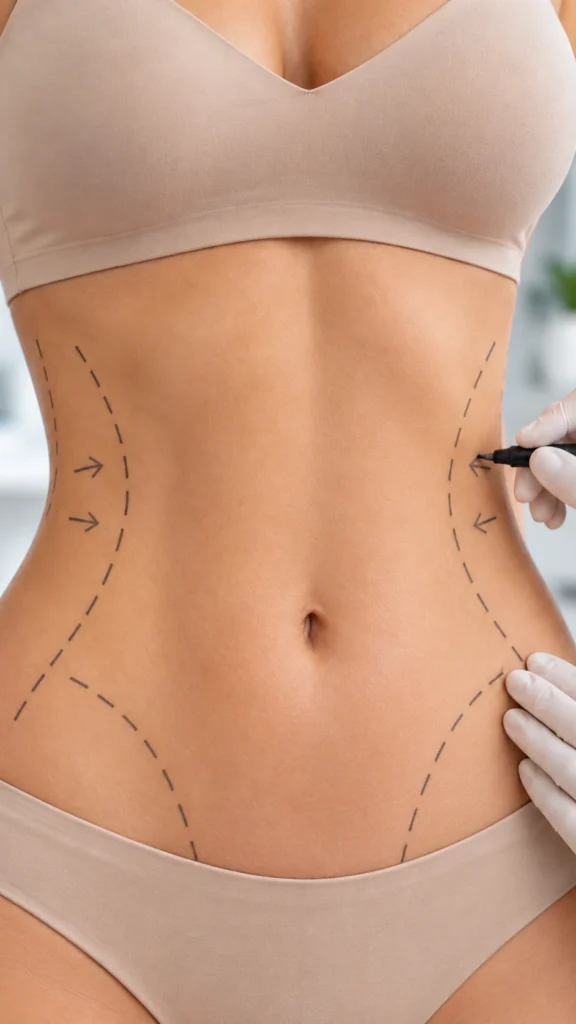
People considering body contouring often want to know exactly how many liters of fat a surgeon can remove and how much weight they might lose afterward. While these questions are understandable, liposuction focuses primarily on reshaping specific body areas rather than producing significant weight loss.
Understanding how fat removal works, what determines safe extraction volumes, and how the body changes after surgery can help patients establish realistic expectations.
Table of Contents
ToggleHow Much Fat Can Liposuction Safely Remove at Once?
The maximum amount of fat removed during a single session depends on several individual factors. Surgeons consider the patient’s overall health, body mass index (BMI), treatment areas, blood loss, fluid balance, and the extent of surgery.
A commonly discussed reference point is 5 liters of total aspirate.
The American Society of Plastic Surgeons identifies procedures involving more than 5,000 milliliters of total aspirate as large-volume liposuction. Its safety recommendations call for additional facility safeguards and postoperative monitoring when surgeons anticipate removing larger volumes.
However, 5 liters does not represent a universal safe limit for every patient. Some individuals require much smaller extraction volumes, while carefully selected patients may undergo larger-volume procedures in appropriately equipped medical facilities.
What Does 5 Liters of Fat Removal Actually Mean?
One of the biggest misunderstandings surrounding liposuction concerns the difference between total aspirate and pure fat.
During surgery, the surgeon removes a mixture of substances, including:
Fat cells from the targeted areas
Tumescent solution introduced during the procedure
Small amounts of blood
Other tissue fluids
For example, a total aspirate volume of 4 liters does not necessarily mean the surgeon removed 4 liters of pure fat. The actual fat content could be considerably lower depending on the technique and fluid composition.
This distinction matters because patients sometimes interpret surgical volume estimates as direct measurements of fat loss.
When researching how much fat can be removed with liposuction, patients should always ask whether a quoted number refers to actual fat or total aspirate.
What Factors Determine How Much Fat Can Be Removed?
No two patients have identical body proportions, fat distribution, or medical histories. As a result, surgeons cannot determine an appropriate extraction volume based on appearance alone.
Several factors influence the surgical plan.
Body Weight and Body Mass Index
BMI provides a general indication of body weight relative to height, but it does not reveal exactly where the body stores fat.
Two people with similar BMIs may have very different fat distributions.
One person may carry more subcutaneous fat around the abdomen and thighs, while another may have higher levels of visceral fat surrounding internal organs.
Liposuction targets subcutaneous fat beneath the skin. It does not directly remove visceral fat.
This explains why patients with higher body weights do not automatically qualify for larger fat-removal volumes.
Number and Size of Treatment Areas
The number of body regions involved also influences the total extraction volume.
A procedure targeting a small area beneath the chin generally involves less fat removal than surgery focusing on the abdomen, flanks, and thighs.
Common treatment areas include:
Abdomen and waist
Love handles and lower back
Inner and outer thighs
Upper arms
Hips
Chin and neck
Treating several areas during one operation may increase surgical complexity, operative time, and physiological stress.
Surgeons must balance the desired contour improvement with patient safety.
Skin Elasticity and Existing Fat Distribution
Skin elasticity strongly influences the appearance of the treated area.
Patients with relatively firm, elastic skin may experience smoother skin retraction after fat removal.
Individuals with significant skin laxity may notice loose skin even after the surgeon reduces underlying fat volume.
Removing excessive fat from an area with poor skin elasticity can create irregular contours or make existing skin laxity more noticeable.
For this reason, extracting the maximum possible volume rarely represents the best aesthetic strategy.
Overall Health and Medical History
A patient’s health directly affects surgical planning.
Surgeons assess cardiovascular health, medication use, previous procedures, and other relevant medical factors.
Conditions that increase bleeding risk or complicate fluid management may restrict the amount of fat the surgeon can safely remove.
A qualified aesthetic plastic surgeon evaluates these factors before recommending an appropriate procedure.
Is Removing 5 Liters of Fat in One Session Dangerous?
Large-volume fat removal can increase certain surgical risks, especially when surgeons attempt to treat multiple extensive areas.
Research has associated higher aspirate volumes with increased complication rates in some patient groups. However, no single volume accurately predicts safety for everyone.
A retrospective analysis involving more than 4,500 patients found that complications occurred more frequently in procedures exceeding 5 liters of aspirate than in smaller-volume procedures. Patient characteristics, including BMI, also influenced risk.
What Are the Risks of Excessive Fat Removal?
Potential complications include fluid imbalance, bleeding, infection, blood clots, and adverse reactions associated with anesthesia.
Other possible problems involve:
Uneven skin contours
Persistent swelling
Fluid accumulation beneath the skin
Changes in skin sensation
Visible asymmetry
Delayed healing
Fat embolism and other serious complications
Although severe complications are uncommon, they can become life-threatening.
A responsible surgical plan prioritizes patient safety rather than maximizing the number of liters removed.
Can Surgeons Remove More Than 5 Liters?
Some surgeons perform procedures involving more than 5 liters of total aspirate in carefully selected patients and specialized medical settings.
However, larger extraction volumes require greater attention to fluid management, blood loss, anesthesia, and postoperative monitoring.
Professional guidance differs across countries and medical organizations.
There is no universally established volume beyond which every procedure becomes unsafe, but increasing the extent of surgery requires careful risk assessment.
Patients should avoid choosing a surgical provider solely because they advertise unusually large extraction volumes.
How Many Kilograms Can You Lose After Liposuction?
A common question is whether removing several liters of fat leads to an equivalent reduction in body weight.
The answer depends on the actual amount of fat extracted and the body’s response during recovery.
Liposuction is a body contouring procedure, not a primary weight-loss treatment.
For reference, one liter of human body fat weighs approximately 0.9 kilograms, although the exact relationship depends on composition.
Therefore, removing 3 liters of actual fat would correspond to roughly 2.7 kilograms of fat mass.
However, patients should not expect the weighing scale to show this exact difference immediately.
Why Does the Scale Sometimes Show Little Change?
Several factors can temporarily influence body weight after surgery.
Postoperative swelling, fluid retention, and the body’s inflammatory response can offset the weight of removed fat during early recovery.
As swelling decreases, weight measurements may change.
Patients may also notice that clothing fits differently even when their overall body weight changes only slightly.
This happens because fat removal alters the shape and proportions of targeted areas.
A smaller waist circumference or more defined abdominal contour may represent a more meaningful improvement than the number displayed on a scale.
Can Liposuction Remove Belly Fat Completely?
Abdominal fat removal ranks among the most common reasons patients consider cosmetic body contouring.
However, not all abdominal fat responds to the same treatment.
The body stores fat in different locations, and liposuction cannot eliminate every type.
Subcutaneous Fat vs. Visceral Fat
Subcutaneous fat sits directly beneath the skin. Surgeons can access this layer during liposuction and remove selected deposits to reshape the abdomen.
Visceral fat surrounds internal organs within the abdominal cavity.
Liposuction does not target this deeper fat.
Someone with a prominent abdomen caused largely by visceral fat may experience limited contour improvement from liposuction alone.
In contrast, individuals with localized subcutaneous deposits may notice more visible changes.
A physical examination helps determine which type of fat contributes most to the abdominal appearance.
Will the Stomach Become Completely Flat?
A flat abdomen depends on more than fat volume.
Muscle structure, skin elasticity, posture, and natural body proportions also influence abdominal shape.
Liposuction can reduce selected fat deposits, but it does not tighten separated abdominal muscles or remove substantial excess skin.
Patients should discuss whether their expectations match what fat removal alone can realistically achieve.
Can Multiple Areas Be Treated During One Liposuction Session?
Many patients want to reshape several areas during a single operation.
For example, someone may wish to reduce fat around the abdomen, waist, and back to achieve a more balanced silhouette.
Surgeons sometimes combine treatment areas when the patient’s health and anticipated surgical demands support this approach.
However, each additional area can increase operative time and total aspirate volume.
What Is 360 Liposuction?
360 liposuction refers to body contouring around the torso, usually involving the abdomen, flanks, and portions of the back.
The term describes the treatment regions rather than a separate fat-removal technology.
The goal involves creating smoother transitions between the front, sides, and back of the waist.
Because this approach covers multiple areas, surgeons carefully evaluate the planned extraction volume and total operative time.
The amount of fat removed varies considerably between patients.
Is It Better to Split Liposuction Into Multiple Sessions?
Some patients benefit from staged procedures, particularly when their goals involve several extensive treatment areas.
A staged approach allows the surgeon to address selected regions during one operation and reassess the remaining areas after recovery.
However, multiple sessions also involve additional recovery periods, costs, and cumulative exposure to surgical risks.
The best approach depends on the overall treatment plan rather than the desire to remove the greatest amount of fat in one visit.
Does VASER Liposuction Remove More Fat Than Traditional Liposuction?
Patients comparing techniques often wonder whether advanced technology allows surgeons to remove larger fat volumes safely.
VASER liposuction uses ultrasound energy to help separate fat tissue before extraction.
Traditional suction-assisted liposuction uses a cannula and controlled suction to remove fat deposits.
Both methods can support body contouring, but technology alone does not determine the appropriate extraction volume.
Does the Liposuction Technique Affect Fat Removal?
The surgeon’s technique may influence surgical precision, tissue handling, and treatment planning.
However, the maximum safe extraction volume still depends on the patient’s physiology and the extent of surgery.
Using ultrasound-assisted technology does not eliminate the risks of fluid imbalance, bleeding, burns, or other complications.
Patients comparing techniques should focus on the surgeon’s experience, their individual anatomy, and the expected aesthetic outcome rather than assuming one method always removes more fat.
How Long Does Recovery Take After Fat Removal?
The recovery period depends on the number of treated areas, extraction volume, surgical technique, and individual healing.
Patients who undergo relatively limited procedures may return to light daily activities sooner than those recovering from more extensive body contouring.
Swelling, bruising, tenderness, and temporary changes in sensation commonly occur during early recovery.
What Happens During the First Few Weeks?
During the initial recovery period, swelling can temporarily obscure the new body shape.
Surgeons may recommend compression garments to support the treated areas and help manage postoperative swelling.
Gentle walking often forms part of the recovery plan because movement supports circulation.
However, patients should follow their surgeon’s specific instructions concerning exercise, lifting, and physical activity.
The extent of surgery determines how quickly normal activities can resume.
When Will the Final Body Shape Become Visible?
Body contours typically change gradually as swelling decreases.
Many patients begin noticing clearer improvements within several weeks, while additional refinement may continue over several months.
Some swelling can persist for longer, particularly after extensive procedures.
Patients who maintain a relatively stable weight may preserve their new proportions more effectively over time.
However, the body can still store fat in remaining fat cells, and substantial weight fluctuations may change the treated areas.
Liposuction in Turkey: What Should Patients Know About Fat Removal Limits?
People researching liposuction in Turkey often compare treatment techniques, the number of areas surgeons can address, and expected fat-removal volumes.
However, the most important consideration is whether the surgeon recommends an approach that matches the patient’s anatomy, medical history, and safety requirements.
Some individuals explore several options within Body Surgeries in Turkey,particularly when their aesthetic goals involve more than one body region.
Understanding the difference between localized fat reduction, skin tightening, and other body contouring procedures helps patients establish realistic expectations.
Before scheduling surgery, patients should ask about the expected aspirate volume, surgical facility, anesthesia plan, and postoperative monitoring.
Patients traveling internationally should also discuss how long they need to remain near their surgical team, when they can safely fly, and how they will access medical care after returning home.
Travel arrangements should support the recovery plan rather than determine how aggressively the surgeon performs fat removal.
How Can You Maintain Your Body Shape After Liposuction?
Although liposuction permanently removes some fat cells from the treated areas, it does not prevent future weight gain.
Remaining fat cells can expand if a person consistently consumes more energy than the body uses.
This means long-term body contour maintenance depends partly on daily habits.
Can Fat Return After Liposuction?
The extracted fat cells do not simply regenerate in their original numbers under ordinary circumstances.
However, the remaining fat cells can increase in size.
Future weight gain may affect both treated and untreated body regions.
Liposuction also does not prevent normal changes associated with aging, pregnancy, or hormonal fluctuations.
What Habits Help Maintain the New Contour?
A sustainable routine involving balanced nutrition, regular physical activity, and stable weight management can support long-term results.
Strength training may also improve overall body composition and muscle definition, although exercise cannot control exactly where the body stores fat.
Patients should avoid treating surgery as a replacement for healthy lifestyle habits.
The amount of fat removed in one liposuction session matters less than the safety of the procedure and the quality of the final body contour. A carefully planned operation that removes a moderate amount of fat may create a more balanced appearance than an aggressive procedure focused primarily on extraction volume.
Frequently Asked Questions About Fat Removal With Liposuction
1. What Is the Maximum Amount of Fat That Can Be Removed in One Liposuction Session?
The maximum amount varies according to body weight, medical condition, treatment areas, and surgical setting. Surgeons commonly reference 5 liters of total aspirate when discussing large-volume liposuction, but that measurement includes fat and other fluids. It does not mean every patient can safely undergo the removal of 5 liters of pure fat. Larger-volume procedures require careful risk assessment and appropriate medical facilities.
2. Can Liposuction Remove 10 Liters of Fat in One Session?
Removing 10 liters in one operation represents an unusually extensive procedure with potentially serious risks. Some highly specialized surgical settings may manage large-volume cases, but such procedures do not represent routine cosmetic liposuction. Greater extraction volumes can increase concerns involving bleeding, fluid balance, and other complications. Surgeons may recommend staged treatments instead of attempting extensive removal during one session.
3. How Much Weight Will I Lose if 3 Liters of Fat Are Removed?
Three liters of pure fat weigh approximately 2.7 kilograms, but this does not guarantee an immediate 2.7-kilogram reduction on the scale. Surgical swelling, fluid retention, and recovery-related changes can temporarily influence body weight. If the 3-liter figure refers to total aspirate, the actual amount of fat removed will be smaller. Patients should focus on contour changes rather than expecting a precise weight-loss figure.
4. Is It Safe to Remove Fat From the Abdomen, Back, and Thighs in One Session?
Surgeons can sometimes treat multiple areas during one operation, but safety depends on the anticipated total aspirate volume, operative time, patient health, and other factors. Combining large treatment areas may increase surgical demands and recovery requirements. Some patients benefit from dividing the procedure into separate sessions. An individual medical assessment helps determine the most appropriate approach.
5. Will My Body Look Different Immediately After Liposuction?
Patients may notice an early change in body shape, but swelling and bruising often conceal the initial improvement. As healing progresses, the treated areas gradually develop clearer contours. Visible changes commonly continue for several months, depending on the extent of surgery and individual recovery. Maintaining a stable weight can help preserve the improved proportions over time.