


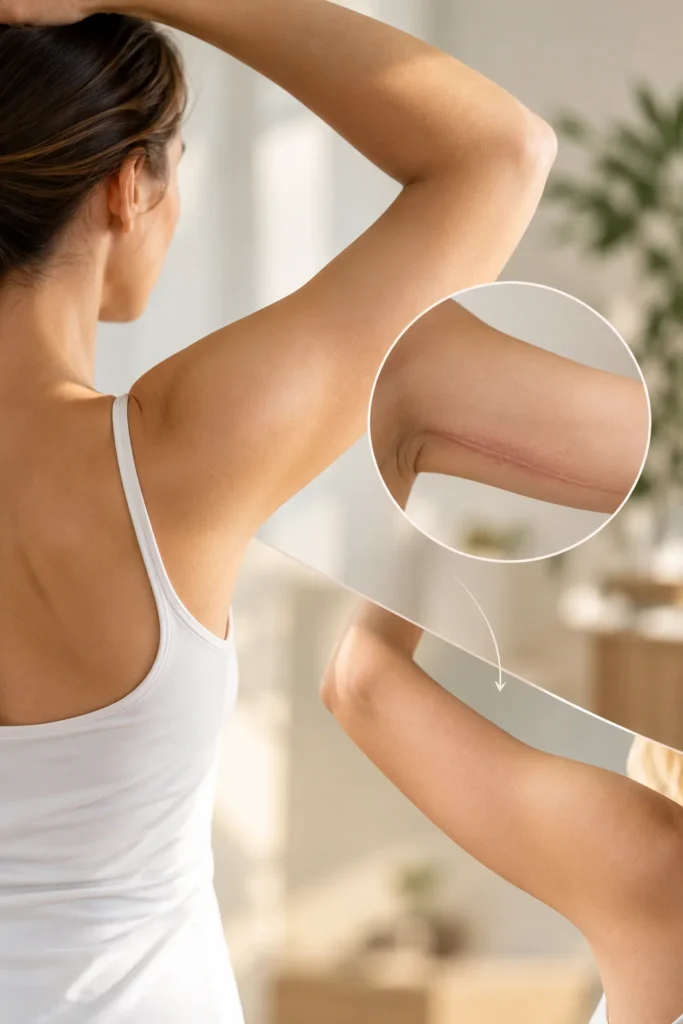
Arm Lift Scars: Where They Are and How to Minimize Them is one of the most common concerns people have before considering an arm lift. Arm lift surgery, also known as brachioplasty, removes excess skin and reshapes the upper arms, but the procedure requires incisions that leave permanent scars. Their exact location and length depend on how much loose skin a person has and the surgical technique the surgeon chooses. While scars do not disappear completely, they usually change significantly over time, and careful scar management can help them become flatter, softer, and less noticeable.
For many patients, the real question is not simply, “Will I have a scar?” but rather, “Where will my scar be, how visible will it look, and what can I do to improve it?” Understanding these details before surgery helps create realistic expectations about both the procedure and the healing process.
Table of Contents
ToggleWhere Are Arm Lift Scars Located?
The location of an arm lift scar mainly depends on the amount and distribution of excess skin. Surgeons plan incisions carefully to remove loose tissue while placing the resulting scar in an area that remains relatively discreet during everyday activities.
In a traditional arm lift, the incision usually extends along the inner or lower part of the upper arm. It may begin near the armpit and continue toward the elbow. When the arms rest naturally beside the body, this position can make the scar less noticeable from the front or back.
However, there is no single incision pattern that works for everyone. Someone with a small amount of loose skin near the armpit may need a much shorter incision than someone who has significant skin laxity after major weight loss.
Does an Arm Lift Always Leave a Long Scar?
No. The length of the scar depends largely on how much skin the surgeon needs to remove.
A mini arm lift may involve an incision limited primarily to the armpit area. This approach generally suits people who have mild skin laxity concentrated in the uppermost portion of the arm.
A standard brachioplasty usually requires a longer incision extending from the armpit toward the elbow. Patients with substantial excess skin may need this approach because a shorter incision would not provide enough access to create the desired contour.
For people researching Arm Lift in Turkey, scar placement should therefore form part of the consultation rather than becoming an afterthought. A surgeon can evaluate the arms and explain the expected incision length before creating a surgical plan.
What Do Arm Lift Scars Look Like After Surgery?
Arm lift scars change considerably throughout recovery. The appearance during the first few weeks does not represent the final appearance.
Initially, the incision line may look red, pink, raised, or firm. Some people also notice mild swelling around the area. These changes form part of the body’s natural wound-healing response.
Over the following months, the scar usually begins to mature. Redness gradually decreases, firmness softens, and the line often becomes flatter. Scar maturation takes time, so comparing a scar at one month with a scar at one year can reveal a substantial difference.
How Long Does It Take for Arm Lift Scars to Fade?
Scar maturation commonly continues for around 12 to 18 months, although every person’s healing timeline differs. Genetics, age, skin characteristics, incision tension, sun exposure, smoking, general health, and aftercare can all influence how a scar develops.
During the early months, the scar may actually appear more noticeable before it starts fading. This can worry patients who expect continuous improvement from the first day. In reality, scar healing does not always follow a perfectly linear path.
Patience matters. A scar that looks prominent three months after surgery may look considerably different after a year.
Can Arm Lift Scars Completely Disappear?
No surgical scar completely disappears. Surgery creates a controlled incision through the skin, and the body repairs that area by producing new tissue.
The goal of scar management is therefore not to erase the scar but to help it mature as favorably as possible.
A well-healed arm lift scar may eventually become a thin, pale line that attracts much less attention than it did during early recovery. However, some people naturally develop thicker, wider, darker, or raised scars.
This is one reason why an experienced aesthetic plastic surgeon evaluates more than just how much skin needs removal. Skin quality, previous scar history, incision placement, and tension on the wound can also influence surgical planning.
How Can You Minimize Arm Lift Scars?
Scar appearance depends partly on factors outside a patient’s control, particularly genetics. However, good postoperative habits can support the healing process and reduce avoidable problems.
Follow Your Surgeon’s Wound-Care Instructions
The early healing period plays an important role in how the incision develops. Keep the surgical area clean according to your surgeon’s instructions and avoid applying random creams, oils, or cosmetic products before receiving approval.
Your surgeon may also recommend dressings, compression garments, silicone products, or other forms of scar care at specific stages of recovery.
Starting a product too early does not necessarily improve healing. Timing matters, especially while the incision remains fresh.
Avoid Putting Too Much Tension on the Incision
Lifting heavy objects or making strenuous arm movements too early can place unnecessary tension on healing tissue.
Excessive tension may contribute to scar widening in some cases. This does not mean you need to keep your arms completely still. Instead, follow the activity restrictions your surgical team provides and return to exercise progressively.
The first weeks after surgery focus on protecting the healing incision rather than testing how quickly you can return to your normal routine.
Protect Arm Lift Scars From the Sun
Sun exposure can make a healing scar darker and more noticeable, particularly during the early stages of scar maturation.
Because upper arms often receive direct sunlight during warmer months, sun protection deserves special attention. Clothing can provide physical coverage, while your surgeon can advise when sunscreen becomes appropriate for the healed incision.
Consistent protection matters because scar pigmentation can remain noticeable long after the rest of the swelling disappears.
Ask About Silicone Scar Treatment
Silicone gels and silicone sheets commonly form part of postoperative scar-management routines. They can help maintain hydration around a healed incision and may support a flatter, softer scar in suitable patients.
However, do not apply silicone directly to an open or incompletely healed wound unless your surgeon specifically instructs you to do so.
Scar care works best as a planned process rather than a collection of products chosen randomly from online recommendations.
Why Do Some People Develop More Noticeable Arm Lift Scars?
Two people can undergo similar procedures and develop very different scars.
Genetics plays a major role. Some people naturally form thin, flat scars, while others have a greater tendency toward hypertrophic scars or keloids. Skin tone can also influence temporary or longer-lasting pigmentation changes.
The amount of tension on the incision matters as well. Removing a significant amount of loose skin can create more tension than a smaller correction. Surgical technique, postoperative activity, wound healing, smoking, infection, and sun exposure can also influence the final appearance.
If you already know that your previous surgical cuts or injuries created thick or raised scars, tell your surgeon during your consultation.
Can Arm Lift Scars Be Hidden?
Scar placement aims to balance effective skin removal with discretion. Surgeons often position the incision along the inner or lower upper arm so that it attracts less attention when the arms rest naturally.
However, certain movements can reveal the scar. Raising the arms, wearing sleeveless clothing, or looking directly at the inner arm may make it visible.
Patients considering arm lift surgery should think about this trade-off carefully. The procedure exchanges loose, hanging skin for a firmer arm contour with a surgical scar.
For some people, this trade-off feels worthwhile. Others may decide that their current skin laxity bothers them less than a permanent scar would. There is no universal answer because personal expectations play an important role.
Does Liposuction Leave the Same Scars as an Arm Lift?
No. Liposuction and arm lift surgery address different concerns.
Liposuction targets excess fat through small access points, so it usually leaves much smaller marks. However, liposuction cannot reliably correct significant loose skin. In someone with substantial skin laxity, removing fat alone may even make the looseness more apparent.
An arm lift directly removes excess skin and therefore requires a longer incision.
Some patients need both fat reduction and skin removal to create a more balanced contour. This distinction also applies to other Body Surgeries in Turkey, where the appropriate technique depends on whether the main concern involves fat, excess skin, muscle structure, or a combination of these factors.
What If an Arm Lift Scar Becomes Thick or Raised?
A scar that remains very red, raised, itchy, firm, or uncomfortable deserves professional evaluation. Some patients develop hypertrophic scars, while people with a tendency toward keloids may experience excessive scar tissue growth.
Depending on the scar and its stage of healing, a surgeon may discuss options such as silicone therapy, steroid treatment, laser-based approaches, or scar revision.
Scar revision does not mean completely removing a scar. Instead, the aim is to improve an unfavorable scar by helping it heal in a more controlled way.
Early communication with your surgical team matters. Do not wait many months while trying multiple home remedies if the scar appears to heal unusually.
When Can You Judge the Final Appearance of an Arm Lift Scar?
Avoid judging an arm lift scar during the first few weeks or months. At that stage, redness, firmness, swelling, and pigmentation can make the incision look much more prominent than it eventually will.
Scar maturation requires months rather than weeks. Many scars continue changing for 12 months or longer.
Before-and-after photographs can also create unrealistic expectations if you do not know when the postoperative image was taken. A three-month scar and an 18-month scar can look dramatically different.
When discussing expected results with your surgeon, ask to see examples at different stages of recovery. This gives you a clearer idea of how arm lift scars typically evolve rather than focusing only on fully healed results.
Frequently Asked Questions About Arm Lift Scars
1. Are arm lift scars permanent?
Yes. An arm lift creates permanent surgical scars because the procedure requires incisions to remove excess skin. However, scars usually mature, soften, flatten, and fade over time. Their final visibility varies from person to person.
2. Where is the scar after an arm lift?
A standard arm lift scar commonly runs along the inner or lower portion of the upper arm, often extending from the armpit toward the elbow. Patients who need less skin removal may have shorter scars concentrated closer to the armpit.
3. How long does it take for arm lift scars to fade?
Most scars continue changing for approximately 12 to 18 months. Redness and firmness generally decrease gradually during this period. Genetics, skin type, sun exposure, wound care, and lifestyle habits can influence the timeline.
4. Can I wear sleeveless clothes after an arm lift?
Yes. Once recovery allows normal clothing choices, you can wear sleeveless tops. The scar may remain visible from certain angles, especially when you raise your arms. As the scar matures and fades, many patients find it less noticeable.
5. What is the best way to minimize arm lift scars?
Follow your surgeon’s postoperative instructions, protect the incision from excessive tension and sun exposure, avoid smoking, and use recommended scar treatments at the appropriate stage of healing. If you notice persistent redness, thickening, pain, itching, or raised scar tissue, contact your surgeon for an assessment.