


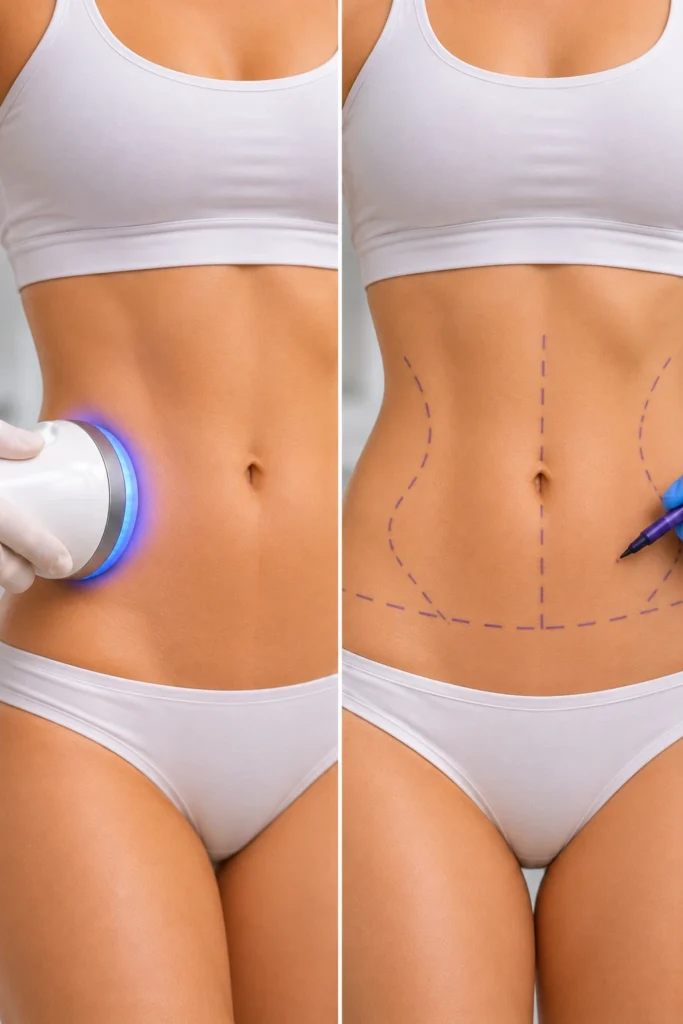
Non-Surgical Tummy Tuck: Can It Replace Surgery? Non-surgical treatments can improve mild abdominal fat deposits, skin texture, and limited skin laxity, but they cannot fully replace a surgical tummy tuck. Technologies such as radiofrequency, ultrasound-based treatments, and non-invasive fat reduction may help refine abdominal contours without surgical incisions. However, these methods cannot remove substantial excess skin or repair separated abdominal muscles in the same way as abdominoplasty. The most suitable approach depends on skin elasticity, fat distribution, abdominal muscle condition, and individual aesthetic goals.
Many people want a flatter, firmer abdomen but hesitate when they think about surgery, scars, and recovery. This makes non-surgical body contouring treatments particularly appealing. Yet the term “non-surgical tummy tuck” can create unrealistic expectations because it describes several different treatments rather than one procedure that duplicates surgery.
Understanding what these treatments actually achieve helps patients decide whether they need subtle contour improvement or more extensive abdominal correction.
Table of Contents
ToggleWhat Is a Non-Surgical Tummy Tuck?
A non-surgical tummy tuck refers to a group of non-invasive or minimally invasive treatments that aim to improve abdominal appearance without traditional abdominoplasty.
These treatments may target localized fat, mild skin looseness, or muscle tone. However, each method addresses a different concern, and no single treatment corrects every cause of abdominal protrusion.
Patients exploring Body Surgeries in Istanbul, Turkey often compare non-surgical body contouring with surgical procedures to understand which approach best matches their needs.
How Does a Non-Surgical Tummy Tuck Work?
Non-surgical abdominal treatments use different technologies to influence fat cells, collagen production, or muscle activity.
For example, certain devices use controlled cooling or energy to reduce small fat deposits. Others deliver radiofrequency or ultrasound energy to encourage collagen remodeling.
Some electromagnetic devices stimulate abdominal muscle contractions to improve muscle tone.
These technologies work through different mechanisms, so their effects and limitations vary considerably.
Is a Non-Surgical Tummy Tuck the Same as Abdominoplasty?
No. Abdominoplasty is a surgical procedure that removes excess abdominal skin and, when appropriate, tightens separated abdominal muscles.
Non-surgical treatments cannot reproduce these structural changes.
Patients considering Tummy Tuck in Turkey should understand that surgery and non-surgical treatments address different levels of abdominal correction.
Can Non-Surgical Treatments Tighten Loose Belly Skin?
Loose abdominal skin develops when the skin loses elasticity after pregnancy, weight fluctuations, or natural aging.
Non-surgical skin-tightening treatments may improve mild laxity, but their effects depend on the amount of excess skin and the patient’s collagen response.
Does Radiofrequency Tighten Abdominal Skin?
Radiofrequency treatments deliver controlled energy into selected skin layers.
This energy generates heat that may stimulate collagen remodeling and gradually improve skin firmness.
Some patients notice subtle tightening over several months, particularly when they have mild skin laxity.
However, radiofrequency cannot remove hanging skin or correct extensive abdominal folds.
Can Ultrasound Treatments Tighten the Stomach?
Certain ultrasound-based devices target tissue at specific depths to encourage collagen remodeling.
These treatments may provide modest improvements in skin firmness for selected patients.
However, treatment effectiveness varies according to the technology, skin characteristics, and degree of laxity.
Patients with significant excess skin generally need a different approach to achieve substantial tightening.
Can a Non-Surgical Tummy Tuck Remove Belly Fat?
Non-invasive fat reduction treatments can target certain localized fat deposits, but they do not replace weight management or surgical body contouring.
These procedures primarily address subcutaneous fat, which sits beneath the skin.
They do not significantly reduce visceral fat surrounding internal abdominal organs.
Does Fat Freezing Work on Belly Fat?
Cryolipolysis uses controlled cooling to affect selected subcutaneous fat cells.
Over the following weeks and months, the body gradually clears some of the affected cells.
This may reduce the thickness of a localized fat deposit.
However, the treatment does not remove loose skin or repair abdominal muscles.
Rare complications, including paradoxical adipose hyperplasia, can cause the treated fat area to enlarge rather than shrink.
Can Non-Surgical Fat Reduction Create a Flat Stomach?
Some patients experience modest improvements in abdominal contours after non-invasive fat reduction.
However, a protruding abdomen may involve several factors, including muscle separation, visceral fat, posture, or excess skin.
Reducing superficial fat alone may not create the appearance the patient expects.
A professional assessment helps identify the primary cause of abdominal fullness.
Non-Surgical Tummy Tuck vs Surgical Tummy Tuck: What Is the Difference?
The main difference involves the extent of correction each approach can provide.
Non-surgical treatments generally target limited concerns without removing skin or surgically tightening abdominal muscles.
A surgical tummy tuck addresses excess abdominal skin and may include muscle repair when the surgeon identifies abdominal wall separation.
Which Procedure Removes Excess Skin?
Surgical abdominoplasty physically removes excess skin from the abdomen.
This makes it particularly relevant for patients who have significant skin laxity after pregnancy or substantial weight loss.
Non-surgical treatments may improve skin firmness, but they cannot eliminate large folds of hanging skin.
Which Procedure Provides More Noticeable Changes?
Surgery generally offers more substantial contour changes when excess skin and abdominal muscle separation contribute to the patient’s concerns.
Non-surgical treatments typically provide subtler improvements.
The difference becomes particularly noticeable in patients with extensive abdominal laxity.
However, surgery also involves incisions, anesthesia, scars, and a longer recovery period.
Can a Non-Surgical Tummy Tuck Repair Diastasis Recti?
Diastasis recti describes a widening of the connective tissue between the left and right rectus abdominis muscles.
It commonly develops during pregnancy but can also occur in other circumstances.
The condition may contribute to abdominal protrusion, although its severity and functional effects vary.
Can Muscle-Stimulating Devices Fix Abdominal Separation?
Electromagnetic muscle-stimulation devices create repeated muscle contractions.
These treatments may improve muscle tone in selected patients, but evidence does not establish them as equivalent to surgical repair of significant diastasis recti.
Some people also benefit from individualized exercise and physiotherapy programs that focus on abdominal function.
The appropriate approach depends on symptoms, the degree of separation, and any associated abdominal wall problems.
When Might Surgical Muscle Repair Be Appropriate?
Some patients with significant abdominal wall separation may consider surgical repair, particularly when they also have substantial excess skin.
During selected abdominoplasty procedures, surgeons bring the separated rectus muscles closer together by tightening the connective tissue between them.
However, not every patient with diastasis recti requires surgery.
A clinical evaluation helps determine whether conservative management or surgical treatment better addresses the patient’s needs.
Can You Get a Flat Stomach Without Surgery?
A flatter abdominal appearance depends on several factors, including body composition, skin elasticity, muscle condition, and genetics.
For some people, exercise, nutrition, and non-surgical treatments provide satisfactory improvements.
Others may continue experiencing loose skin or abdominal protrusion despite maintaining a stable weight.
Can Exercise Replace a Tummy Tuck?
Exercise can strengthen abdominal muscles, improve physical fitness, and support healthy body composition.
However, exercise cannot remove significant excess skin.
It also does not reliably correct every case of abdominal muscle separation.
Patients should distinguish between concerns related to muscle conditioning and those involving structural changes to the abdominal wall.
Does Weight Loss Tighten Loose Abdominal Skin?
Weight loss reduces body fat, but it does not guarantee that stretched skin will return to its previous position.
Skin elasticity depends on age, genetics, collagen characteristics, and the duration and extent of stretching.
Some people experience noticeable skin tightening after gradual weight loss, while others retain excess skin.
Is a Non-Surgical Tummy Tuck Better After Pregnancy?
Pregnancy changes the abdomen in several ways.
The skin stretches, abdominal muscles accommodate the growing uterus, and fat distribution may change.
After childbirth, some changes improve naturally, while others persist.
Can Non-Surgical Treatments Help With a Postpartum Belly?
Selected treatments may improve mild skin laxity or localized fat deposits after pregnancy.
However, patients should allow sufficient postpartum recovery and obtain medical guidance before pursuing cosmetic procedures.
Breastfeeding status, abdominal muscle function, and future pregnancy plans may influence treatment timing.
When Is Surgery More Appropriate After Pregnancy?
Patients with significant excess skin, persistent abdominal wall separation, or pronounced contour changes may consider surgical correction.
However, surgeons generally prefer to evaluate patients after their weight and postpartum recovery have stabilized.
Future pregnancies may stretch the abdominal tissues again and affect the appearance achieved through surgery.
How Long Do Non-Surgical Tummy Tuck Results Last?
The duration depends on the treatment technology, the concern being addressed, and the patient’s lifestyle.
Some non-invasive fat reduction treatments produce changes that can persist when body weight remains stable.
Skin-tightening improvements may gradually diminish as natural aging continues.
Do Non-Surgical Treatments Require Multiple Sessions?
Many non-surgical approaches involve a series of appointments.
For example, some radiofrequency treatments require repeated sessions to achieve noticeable improvements.
Other technologies may involve fewer sessions, depending on the treatment area and device.
Patients should ask about the expected treatment schedule and maintenance requirements before beginning.
Can Belly Fat Return After Treatment?
Non-invasive fat reduction may decrease the number of fat cells in a selected area.
However, remaining fat cells can enlarge with weight gain.
Maintaining a relatively stable weight helps preserve body contour improvements.
Non-surgical treatments do not prevent future changes in body composition.
Is a Non-Surgical Tummy Tuck Safer Than Surgery?
Non-surgical procedures generally avoid the larger incisions, anesthesia requirements, and extended recovery associated with abdominoplasty.
However, they still carry potential risks.
The specific complications depend on the technology and treatment method.
What Are the Risks of Non-Surgical Abdominal Treatments?
Possible side effects include temporary redness, swelling, bruising, tenderness, and changes in skin sensation.
Energy-based treatments can also cause burns or other tissue injuries when practitioners use inappropriate settings or techniques.
Certain fat-reduction procedures carry additional risks, including contour irregularities and rare complications.
Patients should discuss device-specific risks before treatment.
What Are the Risks of Surgical Abdominoplasty?
Abdominoplasty carries surgical risks, including bleeding, infection, fluid accumulation, wound-healing problems, blood clots, and anesthesia-related complications.
Patients also develop permanent scars.
Smoking, certain medical conditions, and significant weight fluctuations may increase some risks.
A thorough medical assessment helps surgeons evaluate individual suitability.
How Much Recovery Does Each Treatment Require?
Recovery represents an important consideration for patients balancing cosmetic goals with work, family, and daily responsibilities.
Non-surgical treatments generally involve shorter recovery periods, although downtime varies by procedure.
Can You Return to Work After a Non-Surgical Tummy Tuck?
Many patients resume routine activities shortly after non-invasive body contouring.
However, temporary tenderness, swelling, or bruising may affect comfort.
Some treatments require short activity restrictions.
Patients should follow the specific instructions provided by their treating clinician.
How Long Does Surgical Tummy Tuck Recovery Take?
Abdominoplasty requires a longer recovery period because the procedure involves tissue removal and sometimes abdominal wall repair.
Many patients need approximately two to four weeks before returning to non-strenuous work, depending on the extent of surgery and their recovery.
Heavy lifting and demanding exercise often require longer restrictions.
Swelling and scar maturation continue beyond the initial recovery period.
Who Is a Good Candidate for a Non-Surgical Tummy Tuck?
Non-surgical body contouring may suit patients who have mild abdominal concerns and realistic expectations about gradual, limited improvements.
Patients with relatively good skin elasticity and small localized fat deposits may benefit more than those with extensive loose skin.
However, treatment suitability depends on the technology and individual medical circumstances.
When Might Non-Surgical Treatment Be Enough?
Non-surgical treatment may suit patients who:
Have mild abdominal skin laxity
Want to reduce small localized fat deposits
Prefer to avoid surgical incisions
Understand that improvements may be subtle
Have realistic expectations about treatment limitations
Do not require significant excess skin removal
When Should You Consider a Surgical Consultation?
Patients with substantial hanging skin, persistent abdominal wall concerns, or pronounced changes after major weight loss may benefit from discussing surgical options.
An experienced aesthetic plastic surgeon can evaluate abdominal anatomy, skin quality, muscle condition, and individual goals to explain the available approaches.
The consultation should also address surgical risks, scar placement, recovery requirements, and realistic expectations.
Frequently Asked Questions About Non-Surgical Tummy Tuck
1. Can a Non-Surgical Tummy Tuck Give the Same Results as Surgery?
No. Non-surgical treatments may improve mild skin laxity, localized fat deposits, or muscle tone, but they cannot reproduce the full effects of abdominoplasty. Surgery removes excess skin and may repair separated abdominal muscles. Patients with significant skin looseness generally need more extensive correction than non-invasive technologies can provide.
2. What Is the Best Non-Surgical Alternative to a Tummy Tuck?
The most suitable treatment depends on the patient’s primary concern. Radiofrequency or selected ultrasound technologies may help with mild skin laxity, while non-invasive fat reduction targets localized subcutaneous fat. Muscle-stimulation devices address muscle conditioning rather than excess skin. No single treatment replaces every aspect of surgical abdominoplasty.
3. Can You Tighten Loose Belly Skin Without Surgery?
Some non-surgical technologies may improve mild abdominal skin laxity through collagen remodeling. However, they generally produce limited tightening compared with surgical skin removal. Patients with significant hanging skin may not achieve their desired appearance through non-invasive treatments alone.
4. Is a Non-Surgical Tummy Tuck Painful?
Discomfort varies according to the treatment technology and individual sensitivity. Some patients experience warmth, cooling sensations, pressure, muscle contractions, or temporary tenderness. Most non-invasive procedures do not require general anesthesia. However, patients should discuss expected sensations and possible side effects before treatment.
5. Can You Have a Non-Surgical Tummy Tuck Before a Surgical Tummy Tuck?
Yes, some patients explore non-surgical treatments before considering abdominoplasty. However, previous treatments may influence surgical planning, particularly when they affect abdominal fat or tissue characteristics. Patients should tell their surgeon about all previous body contouring procedures, treatment dates, and technologies used.