


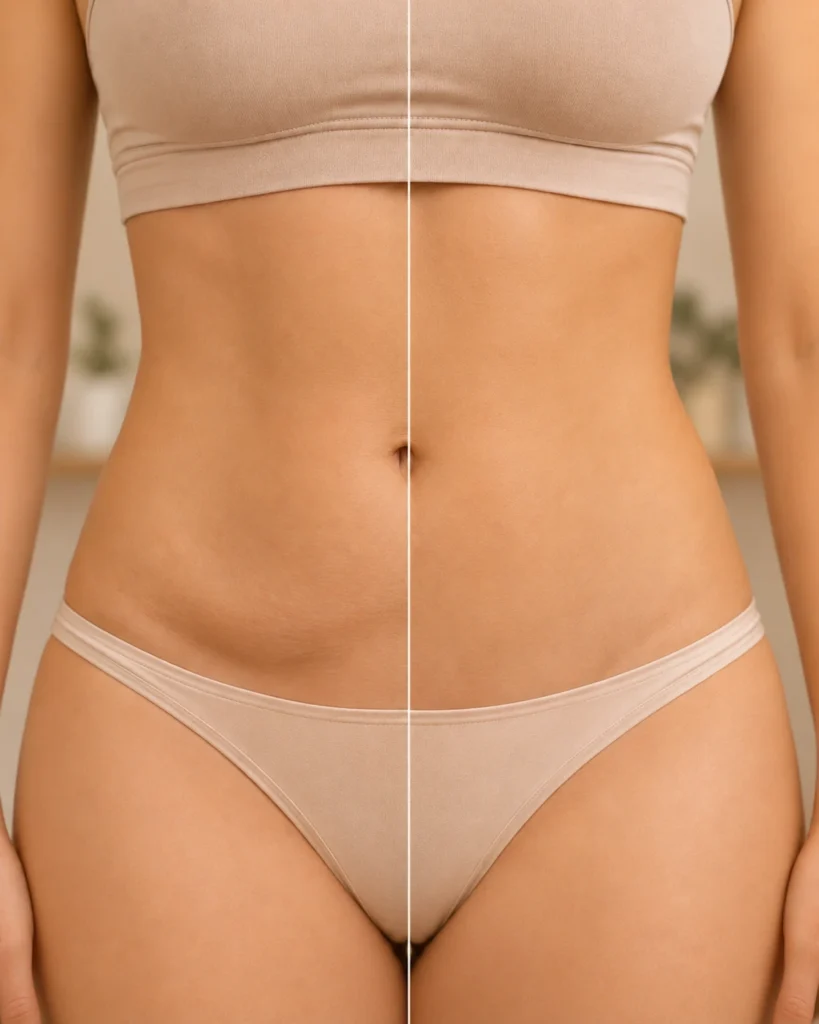
Many people struggle with stubborn abdominal changes despite maintaining a stable weight and exercising regularly. Pregnancy, significant weight fluctuations, and natural aging can stretch abdominal skin and weaken the underlying muscles. Understanding the differences between mini and full abdominoplasty can help you identify which procedure may address your specific concerns.
Table of Contents
ToggleWhat Is the Difference Between a Mini Tummy Tuck and a Full Tummy Tuck?
The main difference between mini and full abdominoplasty lies in the amount of skin removal, the treatment area, and the extent of muscle repair.
A mini tummy tuck focuses primarily on the lower abdomen. A full tummy tuck treats a larger area, including the skin above and below the belly button.
Patients researching Tummy Tuck in Turkey often compare these procedures to understand which technique best matches their body proportions and recovery expectations.
What Is a Mini Tummy Tuck?
A mini tummy tuck, also known as mini abdominoplasty, targets excess skin and selected fat deposits below the belly button.
Surgeons typically create a relatively short horizontal incision above the pubic area. They remove a limited amount of skin and may tighten the lower abdominal muscles when necessary.
The procedure generally does not require repositioning the belly button.
A mini tummy tuck may address:
Mild loose skin below the navel
A small lower abdominal bulge
Limited lower abdominal muscle laxity
Minor changes following pregnancy
Persistent lower belly skin that exercise cannot tighten
However, this technique cannot adequately correct significant upper abdominal skin laxity or extensive muscle separation.
What Is a Full Tummy Tuck?
A full tummy tuck, or complete abdominoplasty, addresses excess abdominal skin and weakened muscles across a larger area.
Surgeons typically create a horizontal incision along the lower abdomen and another incision around the belly button.
They lift the abdominal skin, repair muscle separation when appropriate, and remove excess tissue to improve the abdominal contour.
A full tummy tuck may help people who experience pronounced skin laxity, abdominal bulging, or changes following pregnancy and significant weight loss.
Because the procedure treats a broader area, it generally requires more extensive surgical planning and recovery.
Who Is a Good Candidate for a Mini Tummy Tuck?
A mini tummy tuck usually suits people who have relatively good skin elasticity and limited excess skin beneath the navel.
The ideal candidate often maintains a stable weight but struggles with a persistent lower abdominal concern.
Can a Mini Tummy Tuck Remove a Lower Belly Pooch?
A small lower belly pooch is one of the most common reasons people consider mini abdominoplasty.
However, not every abdominal bulge comes from loose skin.
Subcutaneous fat, muscle laxity, posture, and deeper abdominal fat can all influence the appearance of the stomach.
A mini tummy tuck may improve a bulge caused by localized skin excess or limited muscle laxity.
However, it cannot directly remove visceral fat surrounding internal organs.
Is a Mini Tummy Tuck Suitable After Pregnancy?
Pregnancy can stretch the abdominal skin and contribute to muscle separation.
Some women develop relatively mild changes concentrated below the belly button.
A mini tummy tuck may suit these patients when the upper abdomen remains relatively firm and the muscle separation is limited.
However, many women experience changes across the entire abdominal wall.
Those with significant abdominal muscle separation may benefit more from a full procedure.
Who Needs a Full Tummy Tuck?
A full tummy tuck generally suits patients with more extensive loose skin, abdominal muscle separation, or significant changes after pregnancy and weight loss.
People exploring Body Surgeries in Istanbul, Turkey may compare different body contouring techniques when abdominal skin laxity affects both the upper and lower stomach.
Is a Full Tummy Tuck Better After Major Weight Loss?
Significant weight loss can leave loose abdominal skin that does not shrink completely.
The amount of excess tissue varies depending on age, genetics, weight history, and skin elasticity.
A full tummy tuck can remove selected excess skin and improve abdominal contours.
However, patients with extensive loose skin extending toward the hips or back may need a different body contouring approach.
A surgeon evaluates the distribution of excess tissue before recommending an operation.
Can a Full Tummy Tuck Repair Separated Abdominal Muscles?
Abdominal muscle separation, also called diastasis recti, occurs when the connective tissue between the rectus abdominis muscles stretches.
This condition commonly develops during pregnancy, although other factors can contribute.
A full tummy tuck can address clinically relevant separation by bringing the muscle coverings closer together with sutures.
This may improve abdominal contour and support in appropriately selected patients.
However, surgery does not automatically correct every cause of abdominal protrusion, and not every patient requires muscle repair.
Mini vs Full Tummy Tuck: Which Procedure Leaves a Smaller Scar?
Scarring represents one of the biggest concerns among patients considering abdominal surgery.
Both techniques require incisions, but their lengths and positions differ.
How Long Is a Mini Tummy Tuck Scar?
A mini tummy tuck usually involves a shorter horizontal incision positioned low on the abdomen.
The exact length depends on how much skin the surgeon needs to remove.
Many patients can conceal the scar beneath underwear or swimwear.
However, scar appearance depends on skin characteristics, incision tension, surgical technique, and individual healing.
A smaller incision does not guarantee an invisible scar.
Where Are Full Tummy Tuck Scars Located?
A full tummy tuck generally requires a longer horizontal incision across the lower abdomen.
The surgeon also creates an incision around the navel to accommodate belly button repositioning.
Although the scar is longer, surgeons usually place the main incision low enough for clothing to cover it.
Scar maturation continues over several months and sometimes longer than a year.
Patients should discuss incision placement and scar expectations before surgery.
Does a Mini Tummy Tuck or Full Tummy Tuck Give Better Results?
The quality of the improvement depends on matching the procedure to the patient’s abdominal anatomy.
A mini tummy tuck may create an attractive lower abdominal contour when excess skin remains limited.
However, using a mini procedure when the patient has extensive upper abdominal laxity may leave important concerns untreated.
Similarly, a full tummy tuck may represent unnecessary surgery for someone with minimal lower abdominal skin excess.
Which Procedure Creates a Flatter Stomach?
A flatter abdomen depends on skin elasticity, fat distribution, muscle condition, and natural body proportions.
A mini tummy tuck can improve the lower abdominal profile, while a full procedure may provide broader contour correction.
However, neither procedure guarantees a completely flat stomach.
Visceral fat, skeletal anatomy, and other structural characteristics influence abdominal appearance.
Can You Combine a Tummy Tuck With Liposuction?
Surgeons sometimes combine tummy tuck surgery with liposuction to address selected fat deposits alongside excess skin.
Liposuction targets subcutaneous fat, while abdominoplasty removes excess skin and may repair weakened abdominal muscles.
Combining these techniques may help improve the waistline and overall abdominal proportions.
However, additional treatment increases surgical complexity and may affect recovery requirements.
The surgeon must consider the patient’s health, tissue circulation, and individual surgical goals before recommending a combined approach.
Mini Tummy Tuck vs Full Tummy Tuck Recovery: What Should You Expect?
Recovery differs according to the extent of surgery, muscle repair, individual health, and postoperative healing.
Both procedures involve swelling, discomfort, and temporary restrictions on physical activity.
How Long Does Mini Tummy Tuck Recovery Take?
Many patients return to nonstrenuous work within approximately one to two weeks after mini abdominoplasty.
However, recovery depends on the extent of tissue removal and whether the surgeon repairs the muscles.
Swelling and abdominal tightness can continue for several weeks.
Patients should avoid intense exercise until their surgeon confirms that the tissues have healed sufficiently.
How Long Does Full Tummy Tuck Recovery Take?
A full tummy tuck generally requires more recovery time because the surgeon treats a larger abdominal area.
Some patients return to desk-based work after approximately two to three weeks, although others need longer.
The surgeon may recommend compression garments and temporary activity restrictions.
Heavy lifting and strenuous exercise usually require a longer break, especially when the procedure includes muscle repair.
Residual swelling may continue for several months, and the abdominal contour gradually becomes clearer.
Is a Mini Tummy Tuck Safer Than a Full Tummy Tuck?
A mini tummy tuck usually involves less extensive tissue dissection, which may reduce certain surgical demands.
However, a smaller procedure does not eliminate complications.
Both operations carry risks, including infection, bleeding, fluid accumulation, poor wound healing, changes in sensation, and unfavorable scarring.
Full abdominoplasty may involve greater surgical demands because of the larger treatment area and possible muscle repair.
Serious complications, including blood clots, can occur after either procedure.
A thorough medical assessment and an appropriate surgical setting help reduce avoidable risks.
Can You Get a Tummy Tuck Without Moving the Belly Button?
Many patients specifically ask whether they can improve their abdominal shape without changing the position of their navel.
A mini tummy tuck generally preserves the existing belly button position because the surgeon focuses on tissue below it.
A full tummy tuck usually requires the surgeon to create a new opening for the patient’s existing belly button after repositioning the abdominal skin.
The surgeon does not create an entirely new navel but brings the original structure through the tightened skin.
However, the exact technique depends on the amount of skin removal and individual anatomy.
How Do You Choose the Right Tummy Tuck Surgeon?
Selecting an appropriately qualified specialist plays an important role in surgical planning.
An experienced aesthetic plastic surgeon evaluates abdominal skin, muscle separation, fat distribution, medical history, and aesthetic goals before recommending a procedure.
A consultation should focus on the anatomical changes that concern you rather than automatically recommending the most extensive option.
What Questions Should You Ask During Your Consultation?
Before deciding between mini and full abdominoplasty, consider asking:
Is my loose skin limited to the lower abdomen?
Do I have abdominal muscle separation?
Will the procedure change my belly button?
Where will my surgical scar appear?
How long will I need to avoid strenuous activity?
Can liposuction improve my abdominal contour?
What complications should I understand before surgery?
Reviewing clinical photographs of patients with similar abdominal characteristics may also help clarify realistic expectations.
However, each patient heals differently, and photographs cannot guarantee identical outcomes.
Should You Have a Mini or Full Tummy Tuck Before Pregnancy?
Future pregnancy plans can influence the timing of abdominoplasty.
Pregnancy stretches the abdominal skin and connective tissues, which may change the appearance achieved through surgery.
A future pregnancy can also contribute to renewed abdominal muscle separation.
Patients who plan additional pregnancies may prefer to postpone elective abdominoplasty until they have completed their families.
However, individual circumstances vary, and the decision should follow a discussion with the surgeon.
Does Weight Stability Matter Before Surgery?
Stable weight supports more predictable body contouring.
Significant weight gain after surgery can stretch the remaining skin and alter abdominal proportions.
Similarly, substantial weight loss may create additional skin laxity.
Patients generally benefit from reaching a sustainable weight before planning abdominoplasty.
Neither mini nor full tummy tuck surgery replaces healthy weight management.
Mini Tummy Tuck or Full Tummy Tuck: How Do You Make the Right Choice?
The decision begins with identifying where your abdominal concerns originate.
If loose skin and limited muscle laxity affect only the area beneath your belly button, a mini tummy tuck may provide sufficient improvement.
If excess skin extends above the navel or significant abdominal muscle separation contributes to your concerns, a full tummy tuck may offer a more appropriate surgical approach.
Recovery expectations, incision placement, future pregnancy plans, and individual health also influence the decision.
The smaller operation is not automatically better, just as the more extensive procedure does not guarantee a more attractive abdominal contour.
A personalized examination helps identify the technique that best addresses your anatomy while balancing the desired improvement with surgical safety.
Frequently Asked Questions About Mini vs Full Tummy Tuck
1. How Do I Know If I Need a Mini or Full Tummy Tuck?
A mini tummy tuck may suit you if loose skin and a small abdominal bulge affect only the area below your belly button. A full tummy tuck may be more appropriate when excess skin extends across the abdomen or significant muscle separation contributes to abdominal protrusion. Your skin elasticity, fat distribution, and medical history also matter. A physical examination helps determine which procedure can realistically address your concerns.
2. Is a Mini Tummy Tuck Less Painful Than a Full Tummy Tuck?
A mini tummy tuck often involves less extensive tissue dissection, which may reduce postoperative discomfort for selected patients. However, pain levels vary according to surgical technique, muscle repair, and individual sensitivity. A full tummy tuck may involve greater abdominal tightness, especially when the surgeon repairs separated muscles. Both procedures require appropriate pain management and careful recovery.
3. Can a Mini Tummy Tuck Tighten Abdominal Muscles?
Some mini tummy tuck techniques allow surgeons to tighten the lower abdominal muscles. However, the procedure generally offers limited access to muscle separation above the belly button. Patients with extensive diastasis recti may require a full tummy tuck for broader muscle repair. The surgeon evaluates the location and severity of muscle separation before recommending treatment.
4. Will a Full Tummy Tuck Remove All Stretch Marks?
A full tummy tuck can remove some stretch marks when they lie within the excess skin that the surgeon removes, particularly below the belly button. However, stretch marks above the removed skin usually remain, although their position may change after skin tightening. A mini tummy tuck removes less skin and therefore generally affects fewer stretch marks. Neither operation guarantees complete stretch mark removal.
5. Do Mini and Full Tummy Tuck Results Last Forever?
Both procedures can provide long-lasting abdominal contour improvements, but natural aging, pregnancy, and substantial weight changes may alter the appearance over time. Removing excess skin creates a lasting anatomical change, yet the remaining skin can stretch. Maintaining a relatively stable weight and following postoperative guidance may help preserve the improvement. Neither procedure prevents future changes in body shape.