


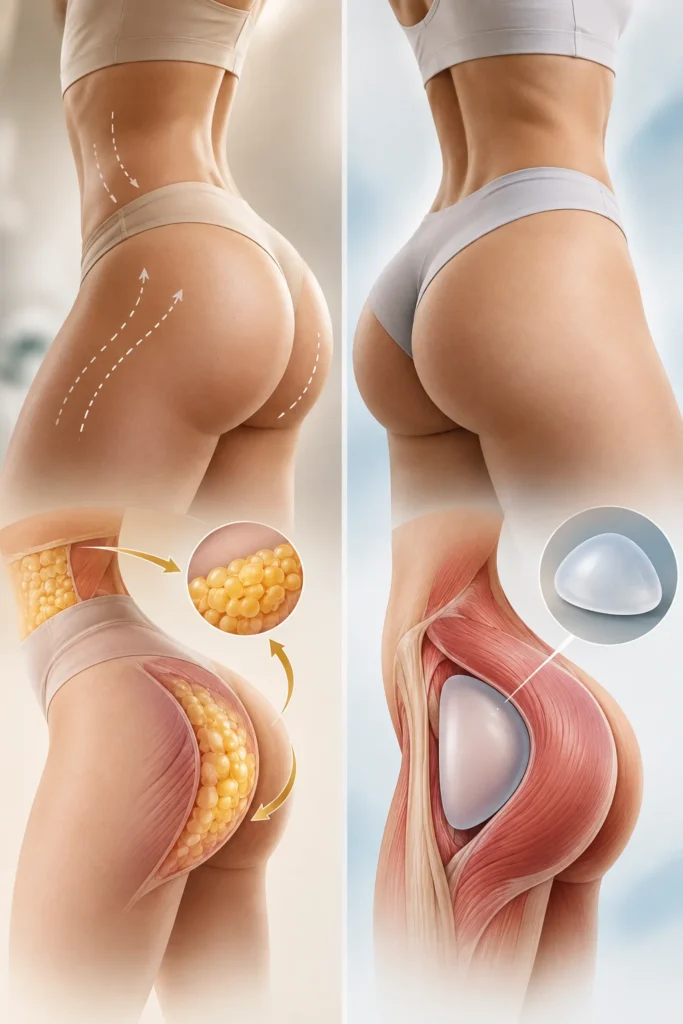
BBL vs Butt Implant: Which Is Better for Your Body Type? The right choice depends mainly on your available body fat, natural proportions, skin quality, desired volume, and the type of result you want to achieve. A Brazilian Butt Lift uses your own fat to reshape and add volume to the buttocks, while butt implants use silicone implants to create projection when fat transfer cannot provide enough volume. Rather than asking which procedure is universally better, it makes more sense to ask which technique suits your anatomy and aesthetic goals.
Both procedures aim to improve buttock shape, projection, and overall body balance, but they take very different approaches. Understanding those differences can help you prepare more realistic questions before a surgical consultation.
Table of Contents
ToggleWhat Is the Main Difference Between a BBL and Butt Implants?
The biggest difference comes from the material that creates the additional volume.
A Brazilian Butt Lift, commonly called a BBL, transfers fat from another area of your body to the buttocks. The surgeon usually removes fat from areas such as the abdomen, waist, flanks, thighs, or lower back through liposuction. After processing the fat, the surgeon strategically injects it to enhance the buttock contour.
Butt implants take a different approach. Instead of using your own fat, the surgeon places specially designed solid silicone implants in the buttock region to increase projection and volume.
This distinction matters because your natural anatomy can make one technique more suitable than the other.
For example, someone with enough unwanted fat around the abdomen and waist may benefit from fat transfer because the procedure can reshape both the donor areas and the buttocks. A very lean person may not have enough fat available for a meaningful transfer, which can make implants worth discussing.
How Does Your Body Type Affect the Choice?
Body type plays an important role when comparing BBL and butt implants. Surgeons do not look only at body weight. They also examine fat distribution, waist-to-hip proportions, pelvic structure, muscle shape, skin elasticity, and your expectations.
If You Have Enough Body Fat
Patients with moderate fat deposits around the waist, abdomen, back, or thighs often have more options for fat transfer.
A BBL can create two changes at the same time: it can reduce fullness in selected donor areas through liposuction and use that fat to improve buttock shape. This combination can make the waist appear more defined while increasing hip or buttock volume.
For patients researching BBL in Turkey, body composition usually matters more than the number on the scale. Two people with the same weight may have completely different fat distribution and therefore require different surgical plans.
If You Are Very Slim
Very lean patients sometimes have limited donor fat. Even if liposuction can collect some fat, the amount may not provide the volume or projection the patient wants.
In this situation, a surgeon may discuss implants, a smaller fat transfer, or another approach depending on the patient’s anatomy.
Patients considering Butt Implant in Turkey should therefore focus on more than simply wanting a larger buttock size. Implant dimensions, muscle anatomy, skin coverage, and natural body proportions all influence the planning process.
If You Have an Athletic Body Type
Athletic patients can present a different challenge. They may have strong gluteal muscles but relatively little body fat.
Some athletic patients want more lateral hip fullness, while others want additional backward projection. These goals matter because fat transfer and implants shape the body differently.
A detailed consultation helps determine whether available fat can create the desired contour or whether another method deserves consideration.
Which Procedure Creates a More Natural Look?
Many patients ask this question before anything else.
Fat transfer often creates a softer transition because the surgeon uses the patient’s own fat to shape the buttocks and surrounding areas. Liposuction can also influence the visual result significantly. Removing fat from the waist and lower back may make the buttocks appear fuller even without creating an extreme increase in volume.
Implants can provide stronger and more predictable central projection, particularly for people with little donor fat. However, implant size, placement, tissue thickness, and surgical planning strongly influence how natural the final contour looks.
The word “natural” also means different things to different patients.
One person may want a subtle hourglass shape. Another may want noticeably stronger projection. A third patient may care more about improving hip dips than increasing overall buttock size.
For that reason, reference photos and specific descriptions often communicate goals more clearly than phrases such as “natural,” “big,” or “small.”
BBL vs Butt Implants: Which Gives More Volume?
Butt implants can provide a defined amount of structural volume because the implant itself creates projection.
BBL volume depends on several factors, including how much donor fat the surgeon can collect, how much fat the treatment plan requires, and how the transferred fat settles during recovery.
This means that patients seeking a dramatic increase but who have very little body fat may have fewer fat-transfer options.
However, more volume does not automatically create a better result. Proportion often matters more than size.
A buttock shape that matches the waist, hips, thighs, and overall frame can look more balanced than simply maximizing projection.
What Happens to the Fat After a BBL?
One of the most common questions about BBL involves fat retention.
After fat transfer, the body establishes a blood supply for part of the transferred fat. Some fat may not remain long term, which means the initial postoperative volume does not always represent the final appearance.
Weight changes can also influence transferred fat because the surviving fat cells behave similarly to other fat cells in the body.
For this reason, maintaining a relatively stable weight after recovery can help preserve overall proportions.
Patients should also understand that surgeons plan fat transfer around both safety and anatomy rather than simply injecting the largest possible amount.
Can Butt Implants Move or Feel Unnatural?
Patients often worry about whether implants can shift or become noticeable.
Implant position depends on several factors, including implant size, surgical pocket, tissue coverage, muscle anatomy, healing, and postoperative activity.
A carefully selected implant aims to match the patient’s frame rather than overwhelm it. Choosing an implant that looks disproportionately large for the available tissue may create aesthetic or practical concerns.
During consultation, the surgeon should explain implant position, incision location, expected feel, possible complications, and how future revision surgery may differ from an initial procedure.
Which Procedure Has the Easier Recovery?
Neither BBL nor butt implant surgery offers a completely effortless recovery.
After a BBL, patients usually need to protect the transferred fat during the early healing period. Surgeons may give specific instructions regarding sitting, sleeping positions, compression garments, walking, and returning to exercise.
Implant surgery involves healing around the surgical pocket and incision. Patients may experience tightness, swelling, discomfort, or movement restrictions during the first stages of recovery.
The exact timeline varies according to the surgical technique, individual healing response, and whether the surgeon combines the procedure with liposuction or other operations.
Rather than comparing recovery only by the number of days, patients should consider how each option may affect sitting, work, exercise, travel, and daily routines.
What If You Want Both Waist Definition and Buttock Enhancement?
Patients who want an hourglass silhouette often focus heavily on buttock volume, but the waist and surrounding areas can influence the overall appearance just as much.
Liposuction around the waist, flanks, or lower back can sometimes create a stronger visual contrast between the waist and hips.
This explains why BBL planning often focuses on the entire torso rather than treating the buttocks as an isolated area.
People researching Body Surgeries in Turkey may also encounter combinations that include abdominal, waist, hip, or breast procedures. Combining surgeries requires careful evaluation because longer operations and broader treatment areas can change recovery demands and potential risks.
Is BBL Better for Hip Dips?
BBL can sometimes help soften the appearance of hip dips because fat transfer allows surgeons to target specific contour areas rather than only the central buttocks.
However, pelvic anatomy strongly influences hip shape.
Some people naturally have a more pronounced indentation between the hip bone and upper thigh. Fat transfer may soften that transition, but it cannot completely change underlying skeletal anatomy.
Butt implants generally focus more on buttock projection than directly filling the lateral hip area. For patients whose main concern involves hip dips, this difference may influence the surgical discussion.
Who Might Consider a BBL?
A BBL may suit someone who:
Has enough donor fat for transfer
Wants both liposuction and buttock enhancement
Prefers to use their own tissue
Wants greater control over contouring around the hips and waist
Has realistic expectations about fat retention and final volume
Can follow postoperative sitting and activity instructions
Body weight alone does not determine candidacy. Fat distribution and overall health also matter.
Who Might Consider Butt Implants?
Butt implants may enter the discussion when someone:
Has very little donor fat
Wants stronger buttock projection
Cannot achieve the desired volume through fat transfer alone
Understands the differences between implants and fat transfer
Accepts the possibility of future implant-related surgery
Has suitable anatomy for implant placement
An experienced aesthetic plastic surgeon should evaluate these factors individually rather than recommend the same technique to every patient.
Can You Combine Butt Implants With Fat Transfer?
In selected cases, surgeons may discuss a combined approach.
An implant can provide central projection, while limited fat transfer can help refine surrounding contours. This approach does not suit every patient, and adding procedures can increase surgical complexity.
The decision depends on available fat, tissue thickness, implant size, anatomy, and aesthetic goals.
Patients should avoid choosing a combination simply because it sounds more comprehensive. The surgical plan should solve a specific anatomical concern.
BBL vs Butt Implant: Questions to Ask Before Choosing
A consultation becomes much more useful when you arrive with specific questions.
Consider asking:
Do I have enough donor fat for a BBL?
Which areas would you use for liposuction?
What changes can I realistically expect in my hip-to-waist ratio?
Would implants suit my frame better than fat transfer?
How much projection fits my body proportions?
How might my weight affect the long-term result?
What restrictions should I expect during recovery?
What complications should I understand for each option?
Could my desired result require more than one procedure?
How would you adapt the plan to my specific anatomy?
The answers should focus on your body rather than generic before-and-after examples.
Frequently Asked Questions
1. Is BBL better than butt implants?
Neither option works better for every patient. BBL often suits people who have enough donor fat and want simultaneous body contouring, while implants may suit lean patients who want additional projection. Your anatomy and goals should guide the decision.
2. Can skinny people get a BBL?
Some slim patients can undergo fat transfer if they have enough usable fat in areas such as the abdomen, flanks, thighs, or back. Extremely lean patients may not have enough donor fat to achieve the volume they want.
3. Do butt implants look natural?
They can create a balanced appearance when the surgeon chooses an appropriate implant size and position for the patient’s anatomy. Tissue coverage, muscle structure, implant dimensions, and individual proportions all affect the final appearance.
4. Does a BBL last permanently?
A portion of transferred fat can remain long term after healing, but body weight, aging, lifestyle, and individual fat retention can change the appearance over time. Patients should expect the early postoperative shape to evolve during recovery.
5. How do I know whether BBL or butt implants suit my body?
A physical examination gives the clearest answer. The surgeon needs to assess donor fat, buttock shape, hip structure, skin quality, muscle anatomy, overall proportions, medical history, and your desired level of projection before creating an individual treatment plan.