


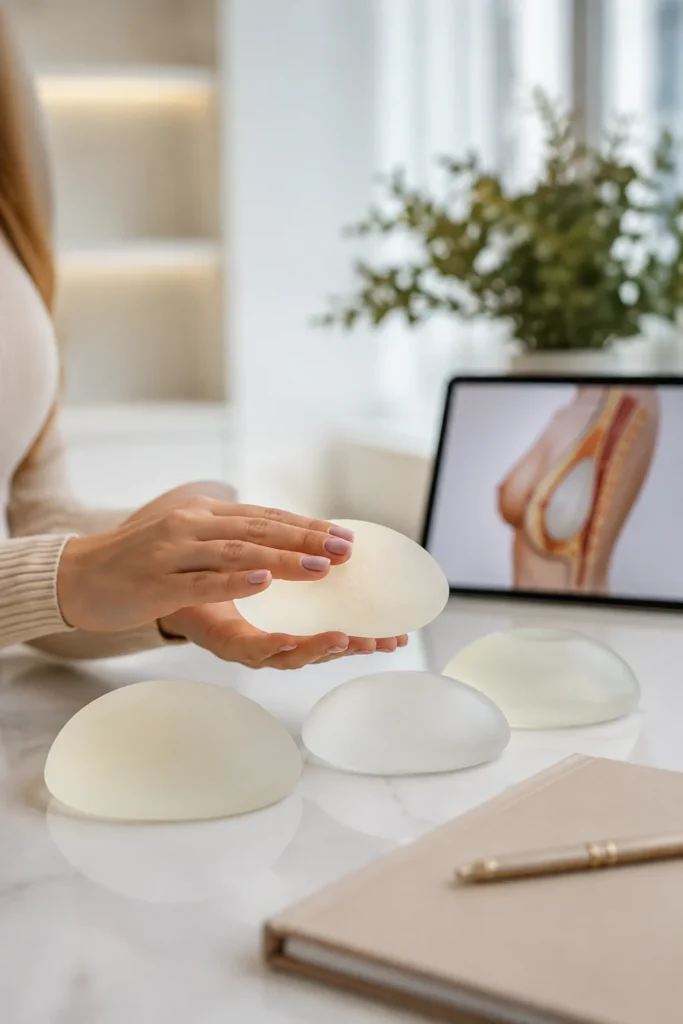
Breast Implant in Turkey: Implant Size Guide helps patients understand how implant volume, body proportions, chest width, breast tissue, and personal aesthetic goals influence the ideal implant size. There is no single implant size that suits everyone, because the same implant can create very different results on two different bodies. A carefully selected implant should complement your natural proportions rather than simply add as much volume as possible. During consultation, an experienced plastic surgeon evaluates your anatomy and helps you choose a size that creates the look you want while maintaining balance and comfort.
Many patients researching Breast Implant in Turkey initially focus on cup size. However, implant selection involves much more than choosing between a B, C, or D cup. Implant volume, profile, width, shape, placement, skin elasticity, and existing breast tissue all influence the final appearance.
Understanding these factors before surgery makes it easier to communicate your expectations clearly and choose an implant that suits your body.
Table of Contents
ToggleHow Are Breast Implant Sizes Measured?
Breast implants usually use cubic centimeters, commonly written as cc, instead of traditional bra cup sizes. Implant volumes can range from relatively subtle sizes to much larger options depending on the patient’s anatomy and expectations.
For example, a 250 cc implant may create a noticeable enhancement on a petite patient with a narrow chest. The same implant may produce only a modest change on someone with a broader frame or more existing breast tissue.
This explains why implant volume alone cannot predict the final cup size.
Bra sizes also vary between brands, making cup size an unreliable measurement for surgical planning. Two bras labeled 34C can fit very differently depending on the manufacturer. Surgeons therefore rely more heavily on anatomical measurements, implant dimensions, and the desired overall shape.
The width of the implant also matters. An implant with a diameter that closely matches the natural breast base generally creates a more proportional appearance. If the implant becomes too wide for the chest, it may extend too far toward the sides. If it remains too narrow, the breast may look unusually projected or lack natural width.
What Determines the Right Breast Implant Size?
Choosing the right implant requires balancing aesthetic expectations with physical characteristics. A good consultation focuses on the entire body rather than evaluating the breasts alone.
Chest and Shoulder Width
Chest width strongly influences implant selection. Patients with narrower rib cages usually require implants with smaller base widths, while broader chests can accommodate wider implants naturally.
Shoulder width also affects visual balance. A breast size that appears prominent on a petite frame may look subtle on a taller or broader patient.
The goal is not necessarily symmetry between individual body measurements. Instead, the surgeon looks at how the breasts relate to the shoulders, waist, hips, and torso.
Existing Breast Tissue
The amount of natural breast tissue plays an important role in implant selection.
A patient with very little breast tissue may need a different implant profile or placement than someone who already has moderate volume. Natural tissue helps cover the implant and influences how soft and gradual the transition from the chest wall to the breast appears.
Patients with thinner tissue may benefit from more conservative implant dimensions if they want to reduce visible implant edges.
Skin Quality and Elasticity
Breast skin must support the implant over time. Younger patients often have firm, elastic skin, while pregnancy, breastfeeding, weight changes, or natural aging can stretch the tissue.
If the skin has significant looseness, simply choosing a larger implant does not necessarily create a lifted appearance. In some cases, the surgeon may discuss additional procedures based on the patient’s anatomy and expectations.
The most suitable approach within Breast Surgeries in Turkey depends on the individual condition of the breast tissue rather than implant volume alone.
Height and Body Proportions
Height can influence how implant volume appears.
A 300 cc implant can look relatively full on someone who is 155 cm tall and quite subtle on someone who is 180 cm tall. Torso length also changes how the breast volume distributes visually across the body.
For this reason, implant selection should focus on proportions instead of chasing a particular number.
Does a Bigger Implant Always Mean a Bigger Cup Size?
Larger implant volume generally creates more breast volume, but the relationship between cc and cup size is not exact.
You may hear estimates such as a certain number of cc creating one cup size increase. These estimates can provide a rough idea, but they should not guide the final decision.
Several factors change how the volume translates visually, including:
Breast base width, existing breast tissue, implant projection, chest shape, implant placement and bra sizing differences.
For example, a wide implant with moderate projection may distribute volume across the chest and create a softer appearance. A narrower implant with higher projection may push the breast further forward and create stronger upper-body definition even when both implants contain similar volumes.
This is why patients considering Breast Implant in Turkey usually benefit more from discussing the desired appearance rather than requesting a specific cup size.
Understanding Breast Implant Profiles
Implant size and implant profile are closely connected, but they describe different characteristics.
Volume tells you how much material the implant contains. Profile describes how far the implant projects forward from the chest.
Common implant profiles include low, moderate, high, and extra-high projection.
A low-profile implant usually has a wider base and less forward projection. It can suit patients who want subtle enhancement or who naturally have a broader chest.
Moderate-profile implants balance width and projection and can create a naturally fuller appearance.
High-profile implants typically have narrower bases with greater forward projection. They may suit patients with narrower chests who want more noticeable fullness without using an excessively wide implant.
Extra-high-profile implants create even greater projection and often produce a more dramatic silhouette.
A skilled plastic surgeon evaluates the implant profile together with the volume. Choosing 350 cc without considering the profile gives only part of the information needed to predict the appearance.
What Do 250 cc, 300 cc and 400 cc Implants Look Like?
Patients frequently compare implant volumes during consultation, but the appearance depends heavily on individual anatomy.
250 cc Breast Implants
A 250 cc implant often creates a relatively subtle enhancement, especially on patients with medium body frames. Petite patients may notice a more significant transformation.
This volume may appeal to someone who wants additional fullness while maintaining a discreet and natural appearance.
300 cc Breast Implants
A 300 cc implant falls within a commonly discussed size range because it can provide visible enhancement without automatically creating a very large breast appearance.
On a smaller frame, 300 cc may look relatively full. On a broader frame, the same size can appear moderate.
350 cc Breast Implants
A 350 cc implant usually creates stronger fullness and projection than smaller options while still allowing a natural-looking result when the dimensions suit the chest.
Patients who want a noticeable change often consider volumes around this range during consultation.
400 cc and Larger Implants
Implants around 400 cc or above create greater volume, but body proportions remain critical.
A 400 cc implant may look balanced on a tall patient with a wide chest but very prominent on someone with a petite frame. Larger implants also place more weight on breast tissue, so surgeons consider skin support and long-term tissue behavior when discussing these options.
These examples offer general guidance rather than fixed visual outcomes.
Natural Look vs. Fuller Look: How Size Changes the Result
Before selecting an implant, it helps to describe the type of appearance you want.
Some patients prefer a subtle enhancement that resembles naturally fuller breasts. Others want visible upper-pole fullness, more cleavage, or a rounder appearance.
For a natural-looking result, the surgeon often focuses on matching the implant width closely to the breast base and maintaining a gradual transition from the upper chest.
Patients who want a fuller look may prefer more projection or additional volume, depending on their anatomy.
Reference photos can help during the consultation. Instead of saying only, “I want a C cup,” showing several examples of breasts you like allows your surgeon to understand your preferred proportions, projection, upper-breast fullness, and overall style.
Images also help identify what you do not want. One patient may dislike excessive upper fullness, while another may specifically request it.
How Implant Shape Influences the Appearance
Implants usually come in round or anatomical shapes.
Round implants distribute volume relatively evenly and can create noticeable upper-breast fullness depending on the size and profile. Many patients choose round implants because they can provide both natural and fuller appearances depending on their dimensions.
Anatomical implants have a teardrop-like shape with more volume toward the lower section. They aim to resemble the natural slope of the breast.
Shape alone does not determine whether breasts will look natural. Implant size, tissue coverage, placement, chest anatomy, and surgical planning all contribute to the final appearance.
When discussing Breast Surgeries in Turkey, patients should view implant shape and size as connected decisions rather than separate choices.
Implant Placement Can Affect How the Size Looks
The surgeon can place breast implants in different anatomical planes depending on the patient’s breast tissue, body structure, implant choice, and surgical plan.
Placement affects how clearly the implant edges appear and how the breast transitions from the chest.
Patients with limited natural tissue often need greater implant coverage to create a smoother contour. Patients with more natural breast tissue may have other suitable placement options.
Even identical implants can appear different depending on placement because muscle and tissue change how the implant interacts with the chest.
For that reason, looking at implant size alone gives an incomplete picture of the expected result.
Should You Choose a Larger Implant Than You Originally Planned?
Some patients worry that they will regret choosing an implant that feels too small. Others fear that a larger size will look unnatural.
Rather than automatically increasing the volume, consider what type of appearance you want in everyday life.
Think about your normal clothing style, physical activity, body proportions, preferred neckline, and how visible you want the enhancement to appear.
A difference of 25 or 50 cc may sound significant when looking at numbers, but visually it can sometimes create a relatively small difference. The implant’s width and profile may influence the appearance more noticeably.
During a Breast Implant in Turkey consultation, trying implant sizers or reviewing three-dimensional simulations can help you compare several options. These tools do not guarantee the exact surgical appearance, but they can make volume differences easier to understand.
Why Choosing the Largest Possible Implant Is Not Always Ideal
Larger implants do not automatically produce a better aesthetic result.
Every breast has anatomical limits. Choosing a size that significantly exceeds the natural breast width or tissue capacity can make the implant look disproportionate.
Implant weight also matters. Larger implants place greater pressure on breast tissue and skin over time. Surgeons therefore evaluate both immediate appearance and long-term tissue support.
A balanced implant should create the desired fullness without ignoring the patient’s natural anatomy.
When a patient wants a dramatic change, the surgeon can discuss how much volume the tissues can comfortably accommodate and which implant dimensions best support that goal.
How to Communicate Your Desired Breast Size
Clear communication plays a major role in implant selection.
Instead of relying only on cup sizes, explain the visual result you want. Words such as subtle, natural, athletic, full, round, projected, soft, or noticeable can help describe your expectations.
Photos make this discussion even clearer.
Choose examples of people with body structures somewhat similar to yours whenever possible. A breast shape shown on someone with a very different height, chest width, or amount of natural breast tissue may not translate directly to your anatomy.
A plastic surgeon can then explain which elements of your preferred examples suit your body and which may require adjustment.
Preparing for a Breast Implant Consultation in Turkey
Patients considering Breast Surgeries in Turkey can prepare for consultation by thinking about their priorities before meeting the surgeon.
Ask yourself how noticeable you want the change to feel. Consider whether you prefer strong cleavage or a more gradual breast contour. Think about the clothing you normally wear and how you want your proportions to change.
It also helps to bring several reference images rather than one ideal photo.
During the consultation, the surgeon can measure your chest, evaluate breast symmetry, assess tissue quality, discuss implant shapes and profiles, and compare appropriate size ranges.
The conversation should focus on finding the implant that fits your anatomy and aesthetic expectations rather than choosing the largest or most popular volume.
Finding a Size That Fits Your Body
Choosing implant size works best when you treat the number of cubic centimeters as only one part of the decision.
A 300 cc implant is not automatically small, medium, or large. Its appearance depends on the person wearing it.
Chest width, breast base, implant profile, height, natural tissue, skin elasticity, implant placement, and personal preference all work together.
For patients researching Breast Implant in Turkey, focusing on proportional planning can make the decision much easier. Instead of asking, “Which implant size is best?” a more useful question is, “Which implant dimensions create the appearance I want on my body?”
That approach gives the surgeon more useful information and helps create a breast shape that feels consistent with your overall proportions.
Frequently Asked Questions
1. What is the most common breast implant size?
There is no universal ideal or standard implant size. Many patients discuss mid-range volumes during consultation, but the right size depends on chest width, natural breast tissue, height, body proportions, and aesthetic goals. Two patients choosing the same volume can achieve very different appearances.
2. How many cc does it take to increase one cup size?
There is no exact cc-to-cup-size formula. Bra sizing differs between manufacturers, and the same implant volume looks different on different bodies. Implant width, projection, natural breast tissue, and chest dimensions influence the final cup appearance.
3. Is 300 cc considered a large breast implant?
A 300 cc implant may look full on a petite patient and relatively subtle on someone with a broader chest. Surgeons evaluate volume in relation to body structure rather than categorizing it as simply small or large.
4. Can I choose my implant size before meeting my surgeon?
You can identify a preferred range and bring reference photos, but anatomical measurements should guide the final choice. Your surgeon needs to assess your chest width, breast tissue, skin quality, symmetry, and desired projection before recommending suitable dimensions.
5. How do I know whether my breast implants will look natural?
A natural appearance depends on more than implant size. The implant should suit your breast width, tissue coverage, body proportions, profile, and desired shape. Careful planning with an experienced plastic surgeon can help align the implant dimensions with your natural anatomy and aesthetic preferences.